Tardigrades Became the First Animals to Survive the Vacuum of Open Space
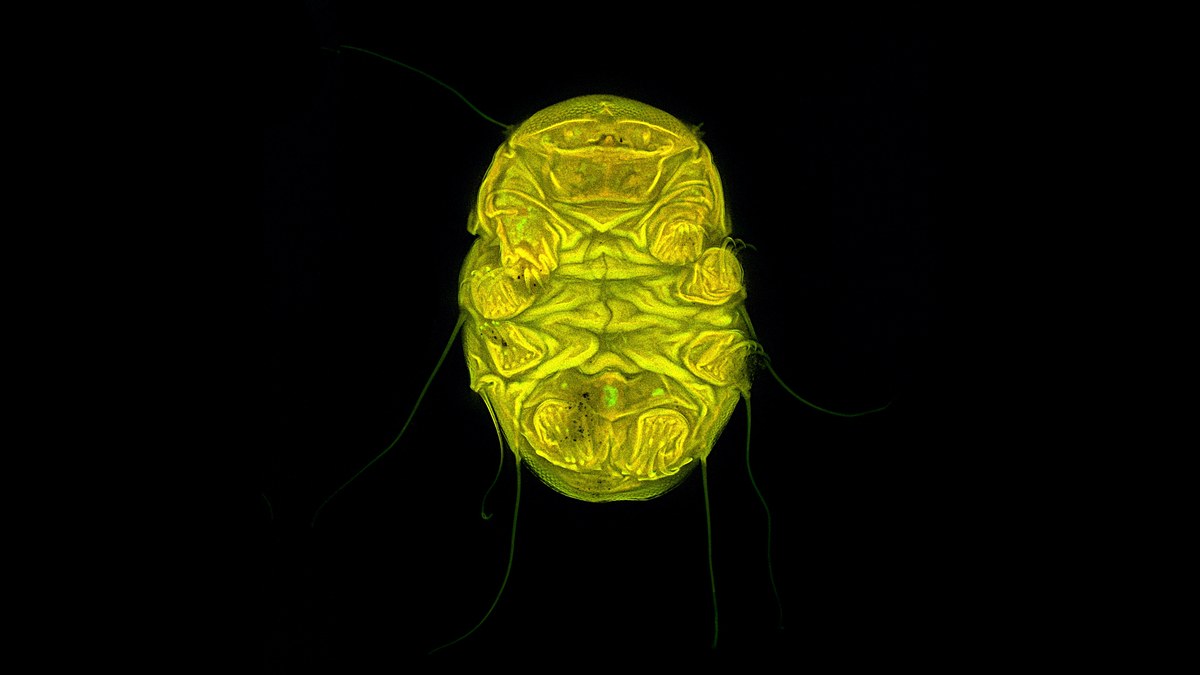
- Tardigrades, also called water bears, are animals only 0.1 to 1.5 mm long, and a 2007 experiment made them the first animals tested in open space.
- Most survived vacuum and cosmic radiation; only a small number survived the full solar ultraviolet dose.
- How they survive the ultraviolet light is still unexplained, and they are fragile in other ways.
The first animals tested in open space
In September 2007 the European Space Agency launched the FOTON-M3 satellite into low Earth orbit, at about 270 kilometers above the surface.[1][2] Among its cargo were tardigrades, nicknamed water bears, tiny animals between 0.1 and 1.5 millimeters long.[1] Before the flight they were dried out. The study, published in Current Biology in September 2008 and led by K. Ingemar Jönsson of Kristianstad University in Sweden, claimed to be the first time any animal had been tested for survival under open-space conditions.[1]
What the animals faced
The experiment, called TARDIS (Tardigrades in Space), exposed adults of two species, Richtersius coronifer and Milnesium tardigradum, for 10 days.[2] They experienced the vacuum of space and cosmic radiation, and some were also exposed to solar ultraviolet (UV) radiation at levels more than 1,000 times higher than at the Earth’s surface.[1] The researchers cite a UV dose of more than 7,000 kilojoules per square meter.[1][2] National Geographic reported this as roughly 350 to 700 times what a sunbather on the Mediterranean receives.[2]
The results
- Vacuum and cosmic rays: most animals of both species survived, and were about as likely to be alive as control animals that stayed on Earth.[1][2]
- Offspring: animals laid viable eggs that hatched as well as ground-based eggs.[2] Survivors reproduced normally after the trip.[1]
- Solar UV: without UV filters most animals died, but a small number survived.[1][2]
Why they can do it
The animals flew in a dry, dormant state called a tun, in which they replace most of the water in their bodies with the sugar trehalose.[2] Jönsson suggested that agents that rely on water or the respiratory system do not work on them in this state.[2] He suspected very efficient DNA repair as the reason some survive intense UV, while the study authors described the UV survival as a mystery and said only that it is conceivable the same adaptations that protect against drying out might explain the hardiness.[1][2]
Limits to the story
Tardigrades are often called indestructible, but the reports are more careful. Before this experiment, only lichens and bacteria were known to survive unprotected exposure to space, and bdelloid rotifers have been reported to be more radiation-resistant than tardigrades.[2] Tardigrades are also very vulnerable to mechanical damage.[2] The sources do not give exact survival percentages for the UV exposure, only that some animals survived. The result shows what the animals can tolerate when dried out in a lab-prepared state, and it does not mean tardigrades live in space or could colonize other worlds.
Sources2tap to view
- ScienceDaily. Tardigrades survive exposure to space (Current Biology, Cell Press release). 2008-09-09. Accessed October 15, 2026.
- National Geographic. Tardigrades become first animals to survive vacuum of space. 2008-09-08. Accessed October 15, 2026.
Both sources report the same experiment. They describe the UV level differently: one compares it with Earth’s surface (more than 1,000 times higher), the other with a Mediterranean sunbather (350 to 700 times the dose). The National Geographic page marked its journal citation as to be confirmed. Neither source gives survival percentages.