
Ethical Considerations of Modern Genetics
Health, environmental, social and political implications of genetic technologies, with genetic discrimination, GM crops, genome editing and debate preparation.
🎯 By the end of this lesson
- Distinguish scientific questions from ethical questions.
- Apply the health, environmental, social and political lenses to a genetic technology.
- Describe how genetic discrimination can occur and how law responds.
- Explain concerns and benefits associated with GM crops using evidence.
- Distinguish somatic from germline editing and treatment from enhancement.
- Evaluate how access and cost affect fairness in reproductive and genetic technologies.
- Prepare a balanced, evidence-based argument for a debate.
1Overview
Science can show how DNA works and how it can be changed. It cannot, alone, decide what should be done. That requires ethics: reasoning about right and wrong, fairness, benefit and harm. The last part of the official content asks students to consider “the health, environmental, social, and political implications of modern genetics.” This lesson gives a framework for doing that, applies it to the technologies from the earlier lessons, and ends with guidance on preparing for a debate.
2Why genetics raises special ethical questions
Several features make genetic technologies different from most others.
- DNA is personal and shared. A person’s genome also contains information about parents, siblings and children.
- Some changes can be inherited. Edits in eggs, sperm or embryos could affect people who have not been born and cannot consent.
- Predictions are probabilistic. Most traits and common diseases involve many genes and the environment, so a result can be misunderstood or cause needless worry.
- The technology moves faster than the rules. Sequencing, for example, became fast and cheap within a few decades of the first genome.
A useful method is to ask the same questions about each technology, through four lenses: health (who benefits or is harmed, and how certain is it), environmental (what happens to ecosystems and biodiversity), social (privacy, fairness, access, stigma) and political (laws, regulation, and who decides).
An ethical question is not the same as a scientific one. Science answers “what is possible and how likely is harm?” Ethics asks “what should be done, and who decides?” Good reasoning separates facts from values and identifies who is affected.
3Health implications
Genetic knowledge can improve health: diagnosing disease, choosing effective drugs (pharmacogenomics), treating inherited disorders with gene therapy and screening newborns. Benefits come with limits and risks.
- Limited prediction. Single-gene defects account for only about 5 percent of diseases in developed countries. Common conditions involve several genes and the environment, so a test may reveal risk without certainty.
- Worry and cost. Genetic screening can be expensive and can cause needless worry. A positive result for a condition with no treatment raises the question of whether a person wants to know.
- Voluntary testing and counselling. Genetic testing is voluntary, and a geneticist or genetic counsellor can explain benefits, limitations and the social and emotional aspects.
- Safety of new treatments. The safety and effectiveness of CRISPR in people are still being determined.
A teenager’s parent has Huntington’s disease, an autosomal dominant condition, so the teenager has a 1 in 2 chance of carrying the allele. A predictive test could give an answer. Health lens: knowing could allow planning, but the result may cause distress. Social lens: the result is also information about siblings and relatives. Political lens: whether insurers or employers may use it depends on law. The example shows that a single test involves all four lenses.
4Environmental implications
Modern genetics affects the environment through agriculture and conservation. The environmental concerns raised about GM crops include escape of engineered genes into wild populations, persistence of those genes, effects on non-target organisms, loss of biodiversity and increased chemical use. Possible environmental benefits include reduced insecticide or herbicide use in some cases, and crops that tolerate drought. Monoculture, even without genetic engineering, reduces biodiversity and can deplete nutrients, as described in the agriculture lesson.
Genetics also supports conservation: measuring genetic diversity, monitoring rare species with environmental DNA and guiding protection planning. Invasive species and the loss of genetic diversity remain central threats.
5Social implications
Privacy and genetic discrimination
Genetic discrimination is the unfair treatment of people based on their genetic information, including family medical history and genetic test results. Examples are insurers using genetic information to decide eligibility or premiums, and employers using it in hiring, firing or promotion. In 2001 the United States Equal Employment Opportunity Commission sued a railroad for secretly testing employees for a rare nerve condition, and the case was settled in 2002.
The United States passed the Genetic Information Nondiscrimination Act (GINA) in 2008. It covers health insurance and employment, but has gaps: it does not cover life, disability or long-term care insurance, does not apply to employers with fewer than 15 employees, and does not restrict the military. State laws form a patchwork. A major concern is that fear of discrimination may discourage people from genetic testing or research.
Access and fairness
New technologies are costly, and access is uneven. IVF illustrates this: public funding in the UK depends on age, number of cycles and local rules, private clinics set their own limits and prices, and clinics abroad may be regulated to different standards. Sickle cell disease and cystic fibrosis affect some communities more than others, so decisions about research priorities and testing programs also have fairness dimensions.
Treatment versus enhancement
Genome editing for serious disease is widely seen as different from editing to enhance traits such as height or intelligence. Germline and embryo editing raises further questions because the changes could be inherited by future generations.
Ethical debates are not simply “for” or “against” science. Most people support some uses and have concerns about others. A person can approve of insulin made in bacteria, ask for strong testing of GM crops, oppose genetic discrimination and still want germline editing to stay prohibited. Strong positions rest on stated reasons and evidence.
6Political implications: law and governance
Societies decide how to use genetics through laws, regulation and international agreements.
- Regulation of GMOs. Governments closely monitor GMOs for food safety and ecological effects. The WHO bases its approach on Codex Alimentarius guidelines, and each GM food is assessed case by case.
- Regulation of editing. Germline and embryo editing is currently illegal in the United States and many other countries.
- Protection of genetic information. Laws on discrimination vary widely by country and region, and gaps remain.
- Research direction. Governments and public agencies fund projects such as the Human Genome Project, which met early opposition: a letter-writing campaign opposed it in 1990.
- Cloning and stem cells. Therapeutic cloning is opposed by some on bioethical grounds, and rules about the use of embryos differ between jurisdictions.
A parliament debating whether GM crops should be grown must weigh farmers’ income, consumer choice and labelling, environmental monitoring and trade rules. No single scientific fact settles that decision, but scientific evidence on safety and ecological effects shapes the options.
7Preparing for a debate
The curriculum suggests activities such as preparing for a debate on the pros and cons of genetically modified organisms, or designing a game to teach others about heredity. A strong approach follows these steps:
- Define the question precisely. “Should GM crops be banned?” is too broad. “Should a GM insect-resistant crop be approved for growing in a region?” can be answered.
- Collect evidence from reliable sources such as health agencies, universities and scientific bodies. Note the date and what each source actually shows.
- Separate facts from values. Safety assessments are facts. Whether a small risk is acceptable is a value judgement.
- Identify everyone affected (patients, farmers, consumers, wildlife, future generations).
- Use the four lenses for each side and list benefits, risks and uncertainties.
- Prepare for the other side. State the strongest opposing argument fairly and respond to it.
- Look for conditions. Many positions are conditional, such as “acceptable if monitored and labelled.”
Claim: “GM foods are unsafe.” A careful response notes that each GM food is assessed case by case, that GM foods on the international market have passed national safety assessments and that no health effects have been shown in the general population where they are approved. It also acknowledges the concerns that remain, such as allergenicity, gene transfer, outcrossing and environmental effects, and notes that these are why assessment and monitoring continue. The answer separates what is known, what is uncertain and what is a value judgement.
8Bringing the course together
The Science 10 biology strand follows one idea: DNA is the basis for the diversity of living things. DNA is copied and packaged in chromosomes, read to make proteins, passed on by Mendelian and other patterns, changed by mutation, sorted by natural selection into adaptations and species, shaped by artificial selection in agriculture, and now read and edited directly. Understanding the science makes it possible to take part in the decisions. Related articles: What is CRISPR? and What is a genome?.
9Case studies for practice
Case 1: a newborn screening program
A province considers adding a condition to newborn screening. For PKU, early detection allows a diet that prevents harm, so the health benefit is large and the test is well established. Questions to weigh: cost, follow-up care for families, what happens to stored samples and information, and how to explain results to parents. If a condition has no effective treatment, the balance of benefits and worries is different, and informed consent and counselling matter more.
Case 2: a company asks for genetic information
An employer offers a wellness program and asks staff to provide genetic information. In the United States, GINA says employers may request genetic information for voluntary wellness programs but cannot reward people for providing it or penalise those who withhold it. Gaps still exist, such as employers with fewer than 15 employees. Social lens: fear of discrimination may stop people from using genetic services. Political lens: the law sets a minimum, and states or other countries can offer stronger protections.
Case 3: a GM crop for drought
A drought-tolerant crop is proposed for a dry region. Health lens: it would be assessed case by case for toxicity and allergenicity. Environmental lens: effects on non-target organisms, possible gene movement into wild relatives and whether chemical use changes. Social lens: farmers’ costs, seed access and consumer choice. Political lens: approval rules and monitoring. The best decision may differ between regions, and evidence on all four lenses is needed.
Case 4: editing an embryo
A clinic proposes using CRISPR to edit an embryo to prevent an inherited disease. The change would be present in every cell and could be inherited. Safety and effectiveness in people are still being determined, and germline editing is currently illegal in the United States and many other countries. Supporters point to preventing serious disease, and critics point to unknown long-term effects, consent of future generations and the risk that treatment could slide into enhancement. A balanced answer states what evidence exists, what is unknown, and which values lead to which conclusion.
Questions to think about
- Should people have a duty to share genetic information with relatives who share the same risk?
- If a technology is safe but expensive, how should access be decided?
- Who should make rules about gene editing: scientists, governments, or the public through debate?
Summary
- Ethical reasoning separates facts from values and considers everyone affected.
- The four lenses (health, environmental, social, political) give a structured way to compare benefits and risks.
- Genetic information is personal and shared, so privacy, consent and fairness are central.
- Laws and regulation differ between places and often lag behind technology.
Tips for writing about ethics
A short written response is stronger when it states a position, gives two or three reasons supported by evidence, names an opposing view and replies to it, and uses precise terms such as somatic, germline, consent and discrimination. Avoid claims that cannot be checked, and say clearly when evidence is uncertain. Quoting a source accurately, and naming its date and author, makes an argument easier to trust.
A note on uncertainty
Ethical decisions are made even when evidence is incomplete. The safety of some genetic treatments in people is still being determined, and long-term environmental effects can be hard to measure. Responsible decisions state what is known, plan to monitor, and stay open to revising the rules as evidence improves.
🔑Key terms
?Quick check
Try each question first, then reveal the answer.
1. Why is the question of whether a technology works different from the question of whether it should be used?
Whether it works is a scientific question answered with evidence, while whether it should be used involves values such as fairness, risk acceptance and who decides.
2. Name the four implications named in the curriculum and give one example of each for GM crops.
Health (allergenicity), environmental (gene escape to wild populations), social (labelling and consumer choice) and political (government regulation and approval).
3. Define genetic discrimination and give two examples.
It is unfair treatment based on genetic information. Examples are a health insurer using test results to set premiums and an employer using genetic information in hiring or firing.
4. Why might people avoid genetic testing even if it could help them?
They may fear discrimination by insurers or employers, or worry about the distress of learning a risk for which no treatment exists.
5. Distinguish somatic from germline gene editing and explain why germline editing is more controversial.
Somatic editing affects only the treated person's non-reproductive cells. Germline editing changes eggs, sperm or embryos, so the change could be inherited by people who cannot consent, and it is illegal in the United States and many other countries.
6. A claim states that all GM foods are dangerous. What does the WHO say about assessing GM foods, and how does that affect the claim?
Each GM food is assessed case by case, so general statements about all GM foods cannot be made. The claim is too broad, although specific concerns such as allergenicity are checked.
7. How does cost affect fairness in access to IVF?
Public funding depends on age, number of cycles and local rules, while private clinics set their own prices, so people with fewer resources may have less access.
8. Outline how to prepare a balanced argument for a debate on a genetic technology.
Define a precise question, gather evidence from reliable sources, separate facts from values, identify those affected, apply the four lenses to each side and prepare a fair response to the strongest opposing argument.
BC curriculum content covered in this lesson
- Ethical considerations: the health, environmental, social, and political implications of modern genetics
Related articles
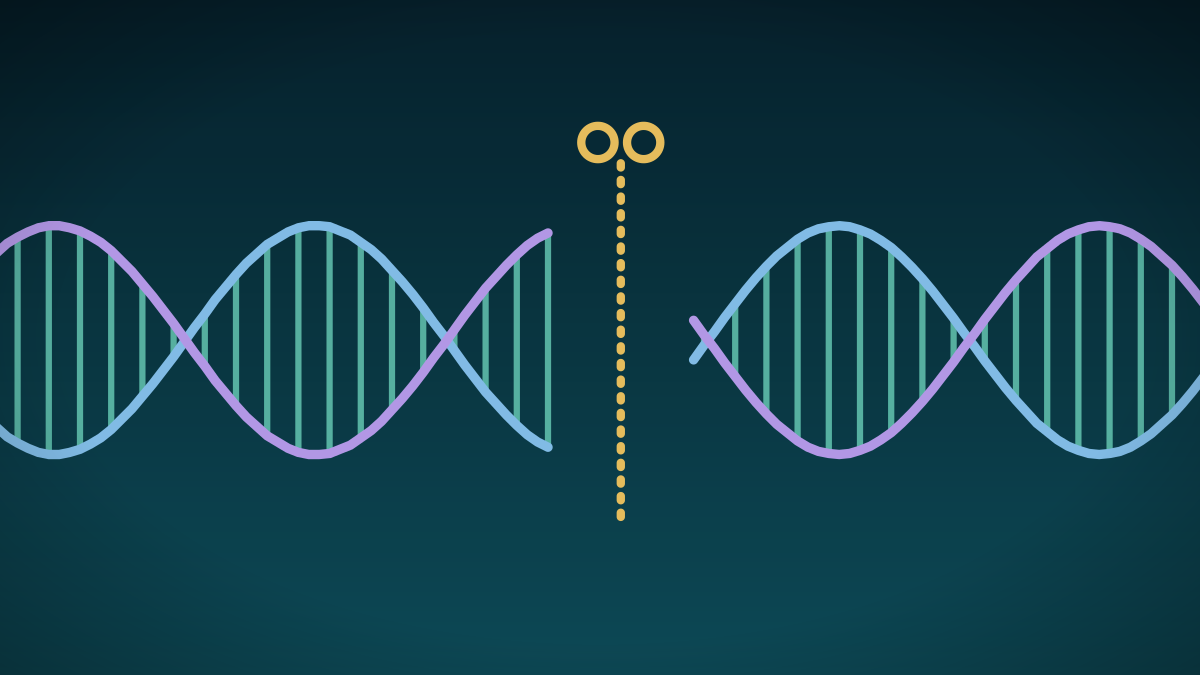
What Is CRISPR? The Gene-Editing Tool Borrowed From Bacteria
CRISPR-Cas9 lets scientists cut DNA at chosen spots using a guide RNA and a Cas9 enzyme, adapted from a bacterial defense system. Health agencies describe its first approved therapy and the debate over editing eggs, sperm and embryos.

What Is a Genome, and What Was the Human Genome Project?
A genome is an organism's complete set of DNA instructions. What that means and how large the human genome is.
References
- BC Ministry of Education and Child Care. Science 10 (curriculum, Content and Elaborations). Accessed October 7, 2026.
- NHGRI. Genetic Discrimination. Accessed October 7, 2026.
- World Health Organization. Food, genetically modified. Accessed October 7, 2026.
- MedlinePlus (NIH). What are genome editing and CRISPR-Cas9?. Accessed October 7, 2026.
- MedlinePlus (NIH). Genetic testing. Accessed October 7, 2026.
- OpenStax. Biology 2e, 17.1 Biotechnology. Accessed October 7, 2026.
- OpenStax. Biology 2e, 17.4 Applying Genomics. Accessed October 7, 2026.
- NHS. IVF. Accessed October 7, 2026.
- NHGRI. Human Genome Project. Accessed October 7, 2026.
- MedlinePlus (NIH). Inheritance patterns. Accessed October 7, 2026.
These lessons follow the content areas listed in the British Columbia curriculum. They are study material written for this site and are not an official document. The official curriculum is the authority on what each course requires. Lessons are general education, not medical advice.