What Are Blood Types and Why Do They Matter?
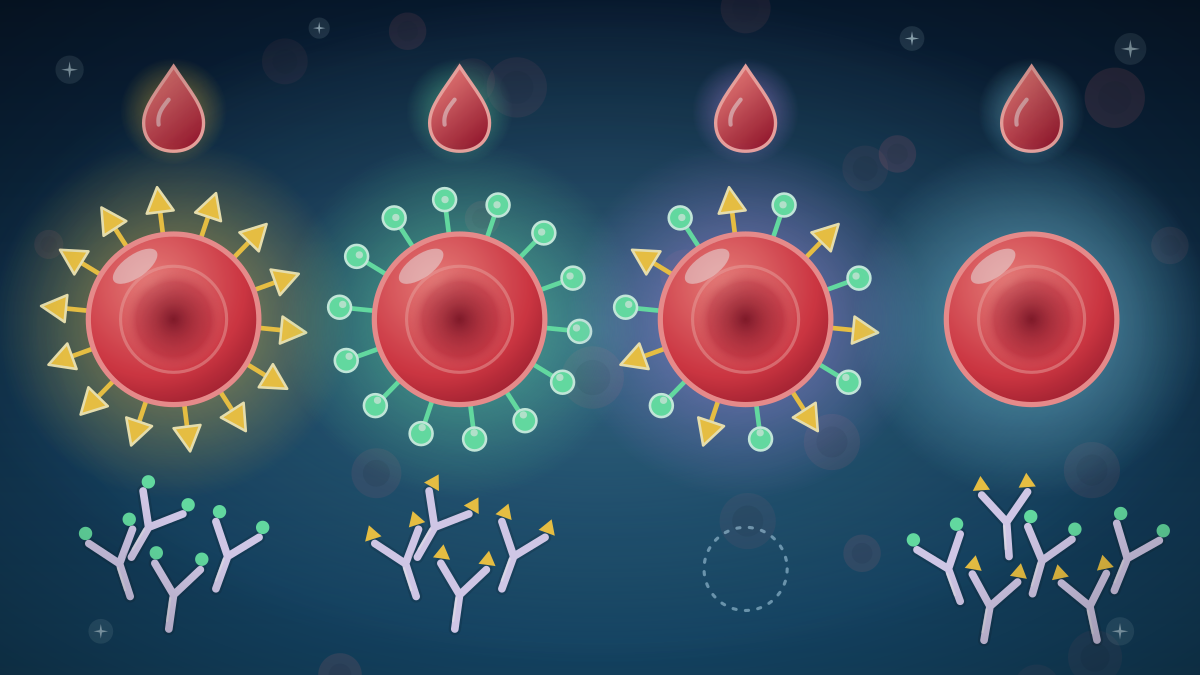
- Four ABO groups combined with Rh positive or negative give eight common blood types.
- A mismatched transfusion can make the recipient's immune system attack donated red cells, with ABO mismatches usually the most severe.
- Type frequencies differ by population: O positive is 37 percent in the US Red Cross figures and about 35 percent in the UK.
General information only, not medical advice. Talk to a doctor or pharmacist about your own health.
Four groups, two Rh results, eight types
Blood type depends on whether certain proteins, called antigens, sit on the surface of red blood cells, and these are inherited from parents.[1] The ABO system has four groups: A, B, AB and O.[1] Group A red cells carry A antigens and the plasma contains anti-B antibodies; group B is the reverse; group AB carries both antigens and has neither antibody; group O carries neither antigen and has both antibodies.[2] Each group is also either RhD positive or RhD negative, depending on whether the Rh protein is present, giving eight common blood groups in all.[1][2]
The American Red Cross adds that more than 300 other known antigens create rare blood types. A type is considered rare if it lacks an antigen that 99 percent of people have, and extremely rare if it lacks one that 99.99 percent of people have.[3]
How the groups were found
Karl Landsteiner explained in 1901 that people have different types of red blood cells and that mixing blood from different people sometimes makes the cells clump together.[4] This made transfusions between people with compatible blood groups much safer, and he received the 1930 Nobel Prize in Physiology or Medicine for the discovery of human blood groups.[4]
Why a match matters for transfusion
A mismatch can cause the recipient's immune system to attack the donated red cells.[1] ABO mismatches are the most common and usually the most severe.[1] The NHS states that group A blood must never be given to a group B recipient, or the reverse, because the antibodies would attack the donor cells.[2]
Group O red cells have no A or B antigens and so can be given to any ABO group. Type O is therefore called the universal red cell donor, and the Red Cross specifies O negative as the type that can be used for any blood type.[1][3] Recipients with type AB can receive any ABO type.[1] The rules for plasma run the other way: the Red Cross names AB as the universal plasma donor.[3] In emergencies when the blood type is unknown, the NHS notes that O RhD negative is often used because it is usually safe for most recipients.[2]
How common each type is
Frequencies depend on the population, so figures from different countries are not interchangeable:
- United States: the Red Cross reports O positive at 37 percent of the population, the most frequent type, and O negative at 7 percent. Type O overall is about 45 percent of Caucasians, 51 percent of African-Americans and 57 percent of Hispanics.[3]
- United Kingdom: group O is about 48 percent of the population, about 85 percent are RhD positive, and O positive is about 35 percent.[2]
The opened pages give no percentages for groups A, B or AB, so none are stated here.
How blood type is tested
Blood typing mixes a blood sample with anti-A and anti-B antibodies, and clumping shows which antigens are present. A second step, back typing, mixes the plasma with known A and B cells to confirm the result.[1] No special preparation is needed.[1] Minor antigens beyond A, B and Rh are not routinely checked in basic typing, so cross-matching and a Coombs test are usually done before transfusions, except in emergencies.[1] GPs in the UK do not routinely check blood group, and one way to find it is to give blood.[2] The NHS gives usual donor eligibility as aged 17 to 65, weighing between 50 kg and 158 kg, and fit and healthy.[2] Blood typing is needed to donate blood or receive a transfusion safely, and it also checks for the Rh factor.[1]
Why Rh matters in pregnancy
All pregnant women in the UK are tested. If the mother is RhD negative and the baby inherits RhD-positive blood from the father, complications can occur if untreated.[2] Careful testing in pregnancy helps prevent severe anaemia and jaundice in newborns.[1] The NHS also says RhD-negative women of childbearing age should only receive RhD-negative blood.[2] This is general information, not medical advice.
Key points
- Blood type reflects inherited antigens on red cells (ABO) plus the Rh protein.[1]
- Matching limits the risk of the immune system attacking transfused cells.[1]
- Type frequencies differ between countries and populations.[2][3]
References
- MedlinePlus (U.S. National Library of Medicine). Blood typing. 2026-01-29. Accessed October 7, 2026.
- NHS. Blood groups. 2023-05-10. Accessed October 7, 2026.
- American Red Cross. Importance of blood types. Accessed October 7, 2026.
- NobelPrize.org. Karl Landsteiner - Facts. Accessed October 7, 2026.
The Red Cross and NHS percentages describe different populations (US and UK) and are not directly comparable; neither opened page gives figures for A, B or AB. The Red Cross page was not dated in the extracted text, so its date is left blank. The Rh and pregnancy section relies on the NHS and MedlinePlus pages only.