Do People Really Use Only 10 Percent of the Brain?
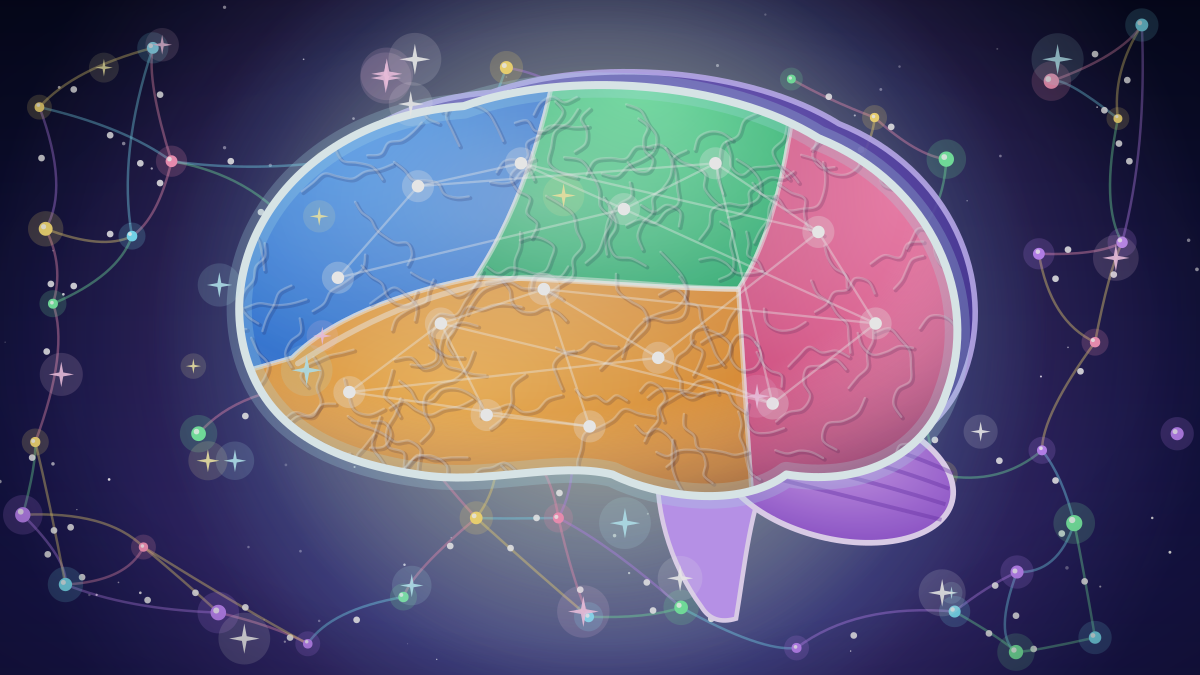
- Brain imaging has found no region that sits unused, and recordings show most areas active across a day.
- Damage to even small parts of the brain has effects, which would not happen if 90 percent were idle.
- The brain is about 3 percent of body weight but uses about 20 percent of the body's energy, according to Scientific American.
Where the claim comes from
The idea that people use only 10 percent of the brain is widely repeated in self-help writing and film, but neuroscientists reject it. Writing in Scientific American, Barry Beyerstein of the Brain Behavior Laboratory at Simon Fraser University traced the claim to a pair of misreadings.[1] William James wrote that people achieve only a small part of their potential, but never gave a percentage or tied the idea to brain tissue.[1] Later self-help authors turned a claim about a fraction of human capacity into a claim about a fraction of brain tissue.[1] In 1936 Lowell Thomas, in a preface to Dale Carnegie's How to Win Friends and Influence People, attributed the claim to James.[1]
Other possible sources have been suggested. Beyerstein notes that the term "silent cortex" and researchers' admissions of ignorance may have been taken to mean that unexplored tissue did nothing, and that the Albert Einstein archives hold no record of him making the statement.[1] NBC News links the myth to experiments by the early twentieth-century neuroscientist Karl Lashley, in which rodents with missing brain tissue could still navigate mazes, a result later misread as spare capacity, and to the 1960s human potential movement.[3] Scientific American's second article says no single origin is definitive.[2]
What brain scans show
Modern imaging has not found a dormant region. Beyerstein reports that EEG, magnetoencephalography, PET, functional MRI and implanted probes have localised many functions, and that no quiet areas awaiting new assignments have emerged.[1] Eric Chudler of the University of Washington told NBC News that there is no part of the brain just sitting there unused, citing EEG and PET scans.[3] Imaging studies cited by Scientific American show that most brain regions are continually active over a 24-hour period, much like the body's muscles.[2] Even during sleep, areas such as the frontal cortex and somatosensory areas remain active.[2]
John Henley, a neurologist at the Mayo Clinic, is quoted as saying that over the course of a day, the whole brain is used.[2] Pouring a morning cup of coffee activates many regions within seconds, including the occipital and parietal lobes, the cerebellum and the frontal lobes.[2]
Damage shows no spare 90 percent
If most of the brain were idle, injury to most of it would be harmless. The reverse is true. Beyerstein states that losing far less than 90 percent of the brain to injury or disease has catastrophic consequences, and that no brain area has been found whose destruction leaves no functional deficit.[1] Larry Squire, a neuroscientist at the VA hospital in San Diego and the University of California, San Diego, told NBC News that any place the brain is damaged there is a consequence.[3]
Neurosurgery points the same way. Electrical stimulation of points on the brain during operations has not uncovered silent areas that produce no sensation, emotion or movement.[1]
Energy and evolution
Brain tissue is expensive to run. Scientific American reports that the brain makes up about 3 percent of body weight, roughly three pounds, yet uses 20 percent of the body's energy.[2] NBC News describes the figure differently, saying the brain uses 20 percent of the body's blood supply.[3] Beyerstein argues that natural selection would not have supported such a costly organ if nine-tenths of it were unused.[1] NBC News makes the same point about evolution.[3]
A fair caveat
Not every neuron fires at the same instant. Scientific American notes that at any given moment not all regions are firing at once, so a person at rest may be using only a fraction of the brain at that moment.[2] That is a statement about moment-to-moment activity across the day, not about 90 percent of the brain being useless.
The same article reports that people with brain injuries or partial removals can sometimes live fairly normal lives because the remaining brain compensates, which is a different matter from the brain having idle reserves.[2] The neurologist Barry Gordon of Johns Hopkins calls the 10 percent idea "so wrong it is almost laughable," and attributes its persistence to people reading their own shortcomings as evidence of untapped brain capacity.[2]
Key points
- Imaging and recording methods have found no unused region of the brain.[1][3]
- Damage to almost any area has consequences.[1][3]
- The 10 percent figure has no known scientific origin and is tied to a misquoted idea about human potential.[1]
References
- Scientific American. Do we really use only 10 percent of our brains? (Barry L. Beyerstein). Accessed October 7, 2026.
- Scientific American. Do People Only Use 10 Percent of Their Brains? (Robynne Boyd). Accessed October 7, 2026.
- NBC News. Myth busted: You only use 10 percent of your brain. Accessed October 7, 2026.
The opened pages describe the 20 percent figure differently: Scientific American says 20 percent of the body's energy, NBC News says 20 percent of the blood supply. None of the three opened pages carried a clear publication date, so reference dates are blank, and the Beyerstein article references work from 1987 and 1999. Sources differ on the myth's origin (William James, Karl Lashley, the human potential movement) and none is definitive. Two of the three sources are popular-press pieces quoting neuroscientists; no peer-reviewed paper was opened.