Why Do People Yawn?
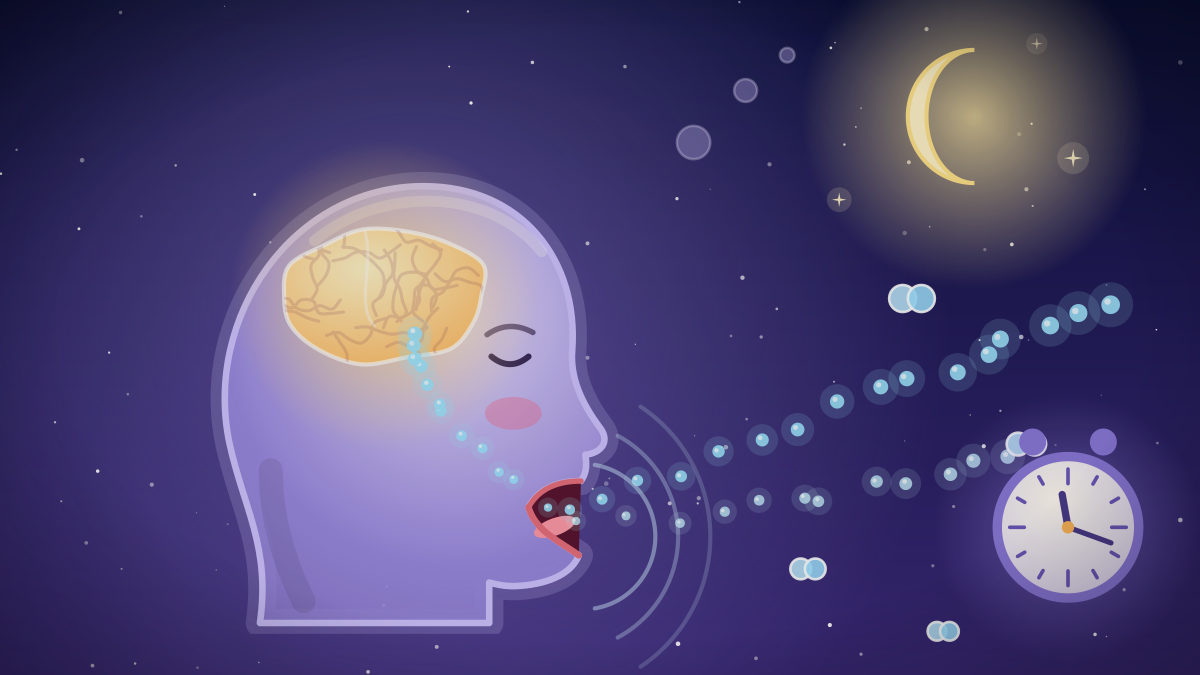
- The old idea that yawns bring in oxygen was not supported: breathing 100 percent oxygen or extra carbon dioxide did not change yawning.
- Brain cooling and arousal are the leading theories, but the cooling evidence rests on small studies and one survey.
- Contagious yawning is more common between close contacts and is thought to be linked to empathy.
A common reflex without a settled explanation
A yawn typically lasts 4 to 7 seconds, according to Cleveland Clinic, while a review in the International Journal of Applied and Basic Medical Research gives an average of about 5 seconds.[1][3] Adults yawn about 9 times a day on average, and some people yawn up to 20 times a day, which can be normal for them.[1] Yawns often come in fits of two or three with rising intensity.[1] Yawning begins before birth: Cleveland Clinic reports that a fetus starts yawning about 12 weeks after conception, and the Indian review notes that yawning has been observed in a 20-week-old human fetus.[1][3]
Despite how familiar the reflex is, no explanation is confirmed. Cleveland Clinic lists three main theories, none proven: arousal, brain cooling and communication.[1]
The idea that did not survive: more oxygen
A popular belief holds that yawning brings in oxygen or clears carbon dioxide. A study by Provine and colleagues found that yawning frequency was unaffected by breathing 3 to 5 percent carbon dioxide or 100 percent oxygen, so the idea has been largely discarded.[3] Cleveland Clinic likewise says the oxygen theory was dropped because a controlled lack of oxygen did not increase yawning, and that it cannot explain yawning in a fetus.[1]
Arousal: waking the brain up
In one study of 48 students, heart rate rose significantly at the peak of a yawn and at 10 and 15 seconds afterwards, compared with baseline.[3] Cleveland Clinic cites a rise in heart rate as support for yawning helping alertness.[1] A review by Gallup and Eldakar, however, notes conflicting evidence about whether yawns really increase arousal.[2] Tiredness is the most common trigger, but boredom, stress, hunger and waking up also feature.[1]
Brain cooling: the thermoregulatory theory
Andrew Gallup of Princeton University and Omar Eldakar of the University of Arizona argue in a 2012 focused review in Frontiers in Neuroscience that yawning helps regulate brain temperature, and describe it as the most parsimonious explanation for yawning in warm-blooded animals.[2] The evidence cited includes:
- In rats, yawns followed rapid brain temperature rises of about 0.11 °C, with drops of 0.5 °C or more occurring within the first minute after yawns.[2] Another summary reports that temperature in a cortical region returned to baseline within about 3 minutes.[3]
- In budgerigars, yawning rose in the 22 to 34 °C range and declined at 34 to 38 °C, when panting increased.[2]
- In a survey of pedestrians in Tucson, Arizona, winter pedestrians (average 22 °C) were nearly twice as likely to yawn as those in early summer (average 37 °C).[2]
These results fit a model in which yawning is most useful when outside air is cooler than the body. Cleveland Clinic notes that yawning occurs around heat stress and hyperthermia.[1]
The review also lists weaknesses in the evidence. The Tucson study was a correlational survey, several key studies are small (two human patients, one drug case report and a few animal samples), and many supporting studies come from the same group of authors.[2] The human temperature data come from two women with chronic excessive yawning, one of whom showed an average oral temperature drop of 0.4 °C after bouts.[2] The proposed cooling mechanisms are largely hypothesised and not directly measured in humans.[2]
Why yawns spread
Seeing or hearing another person yawn can set off a yawn, and it is usually hard to suppress.[1] Contagious yawning is thought to relate to empathy: it is more likely with a close loved one than with a stranger.[1] In an observational study of 109 adults, contagion rose from strangers to acquaintances to friends to kin.[3] Among infants and toddlers observed in one study, 16 of 22 never yawned, and the authors suggested contagious yawning appears only after about 4 to 5 years of age.[3]
Fewer contagious yawns have been reported in people with autism, where one study of 24 children with autism and 25 controls found fewer yawns after watching yawning videos.[3] Gallup and Eldakar add that nasal breathing and forehead cooling reduced contagious yawning in an earlier experiment.[2] The Indian review points out that several studies in this area are small or limited by uncontrolled factors such as drowsiness, and concludes that yawning may serve several functions and that no definitive explanation exists.[3]
When yawning may be a health sign
This is general information, not medical advice. Providers consider yawning excessive at more than three yawns per 15 minutes, several times a day.[1] Cleveland Clinic lists possible causes including sleep conditions such as narcolepsy, sleep deprivation and obstructive sleep apnea, certain medications, and neurological conditions, and suggests talking to a healthcare provider if excessive yawning lasts more than a few days.[1]
References
- Cleveland Clinic. Yawning. 2023-10-16. Accessed October 7, 2026.
- Frontiers in Neuroscience. The thermoregulatory theory of yawning: what we know from over 5 years of research (Gallup and Eldakar). 2013-01-02. Accessed October 7, 2026.
- International Journal of Applied and Basic Medical Research. Yawning and its physiological significance (Gupta and Mittal). 2013-01-01. Accessed October 7, 2026.
No theory of yawning is confirmed. The thermoregulatory review is written by the theory's proponents, and the opened pages differ on duration (4 to 7 seconds versus an average of about 5 seconds). The review date for the Gupta and Mittal paper is given as 2013 (journal issue Jan-Jun). Two PMC pages could not be opened directly because of a verification wall, so the Frontiers copy of the Gallup and Eldakar review was used.