Why Does the Body Get a Fever?
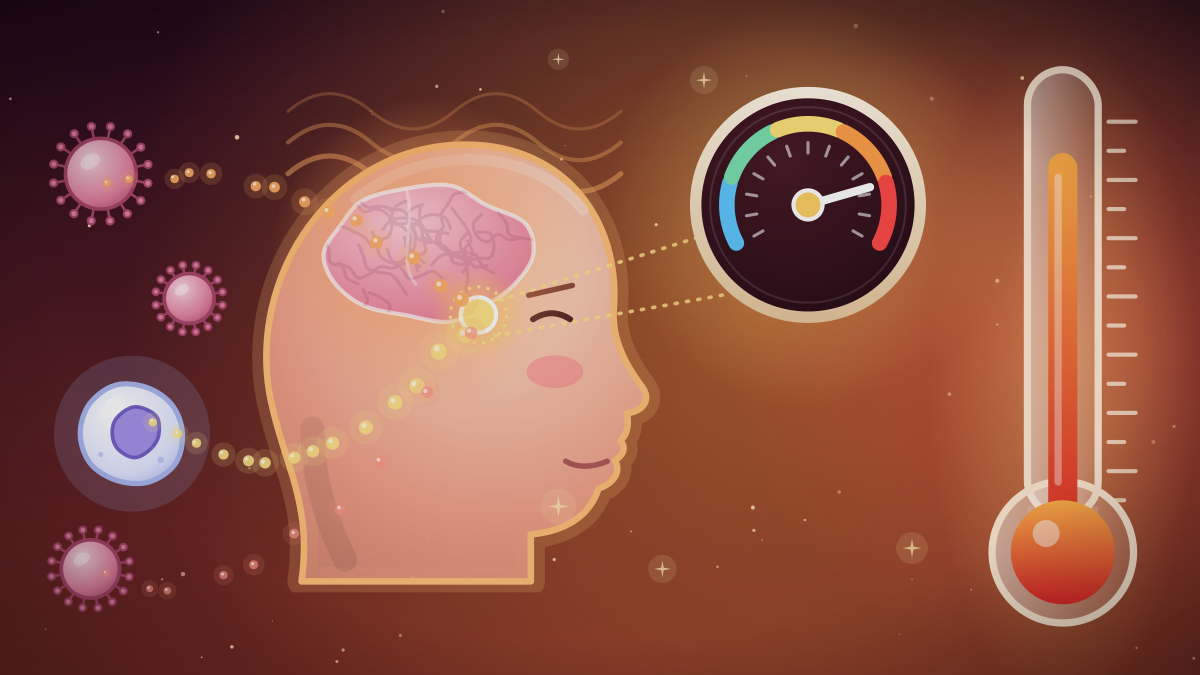
- Fever is a deliberate rise in the brain's temperature set point, usually set off by infection, not a failure of temperature control.
- A 1 degree C rise needs a 10 to 12.5 percent increase in metabolic rate, yet a StatPearls review concludes the benefits outweigh the cost.
- Thresholds vary: 38 degrees C or above in the NHS definition, with grading and measurement site changing the numbers.
General information only, not medical advice. Talk to a doctor or pharmacist about your own health.
A raised set point, not a broken thermostat
A fever is a body temperature above the usual average, and it is a symptom rather than an illness in itself. It is most often the body's response to infection.[1] A common baseline figure is 37 °C (98.6 °F), though individual baselines differ by a degree or more, and temperature normally runs lower in the morning and higher in the evening.[1] Core temperature varies by about 0.5 °C over a day.[2]
The NHS describes a high temperature in adults as usually 38 °C or above.[3] Cleveland Clinic notes that providers cite either 100.0 °F (37.8 °C) or 100.4 °F (38 °C), with 100.4 °F by mouth the most common figure.[1]
How a fever starts
The trigger is usually a pyrogen, a fever-producing substance. Exogenous pyrogens, such as components of bacteria and viruses, stimulate the body's own cells to release endogenous pyrogens, including the signalling proteins IL-1, IL-6, TNF and interferon.[2] These act on the hypothalamus, the brain region that regulates temperature, and raise its set point.[2]
Much of this step runs through prostaglandin E2 (PGE2), which acts on receptors on temperature-controlling neurons in the hypothalamus.[2] Aspirin and acetaminophen lower fever by inhibiting the COX enzymes that help make PGE2.[2]
The key point is that, in a fever, the hypothalamus is working normally but aiming at a higher target. The body regulates its temperature at the new level,. Hyperthermia is a different situation: the set point is unchanged, and body temperature rises uncontrollably because of heat exposure or excess heat production.[2]
Why the body bothers
A fever costs energy. A rise of 1 °C requires a 10 to 12.5 percent increase in metabolic rate.[2] The StatPearls review on fever physiology states that a higher core temperature improves survival and helps resolve infections, and that these benefits outweigh the metabolic cost.[2] It reports that fever activates immune surveillance involving natural killer cells, macrophages, T and B lymphocytes and neutrophils, and that many infectious microbes grow poorly at normal body temperature.[2] The same source says the fever response has evolved in warm-blooded animals over more than 600 million years.[2]
Fever also belongs to the wider inflammatory response. InformedHealth.org, a service of Germany's Institute for Quality and Efficiency in Health Care, lists swelling, warmth and redness, and sometimes fever, as effects of inflammation in the innate immune system.[4] Cleveland Clinic similarly describes a fever as typically a sign that the body is working properly and the immune system is activating.[1]
How high is high?
Grading schemes vary slightly between sources. StatPearls divides fever into low-grade (37.3 to 38.0 °C), moderate-grade (38.1 to 39.0 °C) and high-grade (39.1 to 41 °C), with temperatures above 41 °C (105.8 °F) classed as hyperthermia.[2] Cleveland Clinic gives a low-grade range of roughly 99.5 to 100.3 °F (37.5 to 37.9 °C).[1]
Where temperature is taken also matters. Average readings in StatPearls are 35.97 °C under the arm, 36.57 °C by mouth, 36.64 °C at the eardrum and 37.04 °C rectally.[2] Cleveland Clinic gives the practical rule that rectal and ear readings run about 1.0 °F (0.6 °C) higher than oral readings, while forehead skin readings run about 1.0 °F lower.[1]
What health services say about managing it
This section is general information, not medical advice. For a mild fever under 101 °F (38.3 °C), Cleveland Clinic says medication is usually unnecessary, and that an infection-related fever typically passes within 3 to 4 days.[1] It states that fevers below 103 °F (39.4 °C) are typically not dangerous in adults and that untreated fevers above 105.8 °F (41 °C) can be dangerous.[1] StatPearls cautions that reaching for an antipyretic in every febrile patient is not recommended.[2]
The same Cleveland Clinic page advises that a baby under 3 months with a fever should be taken to the emergency room right away, and that aspirin should not be given to children under 17.[1] It lists warning signs for urgent care, including severe headache, stiff neck, confusion, seizures, difficulty breathing and a fever rash.[1] The NHS advises seeking an urgent GP appointment or calling NHS 111 if a high temperature is not improving with home treatment or is getting worse.[3]
Key points
- Fever is a controlled rise in the hypothalamic set point, usually triggered by infection.[2]
- It differs from hyperthermia, in which the set point does not change.[2]
- Thresholds depend on the source and on where temperature is measured.[1][3]
References
- Cleveland Clinic. Fever. 2023-05-31. Accessed October 7, 2026.
- StatPearls / NCBI Bookshelf. Physiology, Fever (Balli, Shumway and Sharan). 2023-09-04. Accessed October 7, 2026.
- NHS. High temperature (fever) in adults. 2023-05-24. Accessed October 7, 2026.
- InformedHealth.org / NCBI Bookshelf. In brief: The innate and adaptive immune systems. 2023-08-14. Accessed October 7, 2026.
Sources differ slightly on fever thresholds and grades (the NHS uses 38 C or above; Cleveland Clinic cites 100.0 F or 100.4 F; StatPearls and Cleveland Clinic give different low-grade ranges). The claim that fever improves survival is the StatPearls review's own summary of the literature and was not checked against the underlying studies. No separate child threshold was found in the opened pages.