
DNA Structure, Genes and Chromosomes
How DNA is built and copied, what genes and alleles are, how chromosomes package the genome, and how meiosis shuffles genes.
🎯 By the end of this lesson
- Describe the parts of a nucleotide and explain the base-pairing rule.
- Predict the complementary strand for a given DNA sequence.
- Explain why DNA replication is called semiconservative and outline its main steps.
- Distinguish among a gene, an allele, a chromosome and a genome.
- Describe how DNA is packaged into chromosomes using histones, chromatin and the centromere.
- Interpret the basic features of a human karyotype, including autosomes and sex chromosomes.
- Compare mitosis and meiosis and explain how crossing over and independent assortment create variation.
1Overview
A single fertilized egg, smaller than the dot of an i, holds the complete plan for building a person. Somehow that plan is stored, copied billions of times without being lost, and read differently in a nerve cell than in a skin cell. All of that depends on one molecule and the way it is packaged: DNA and the chromosomes that carry it.
This lesson is the foundation for the rest of the biology strand of Science 10: gene expression, inheritance, mutation, evolution and modern genetic technology. The big idea of the course is that DNA is the basis for the diversity of living things, so the first job is to explain what DNA is, what a gene is, and how chromosomes are built and passed on.
2The structure of DNA
DNA (deoxyribonucleic acid) is a long molecule made of smaller repeating units called nucleotides. Each nucleotide has three parts: a five-carbon sugar called deoxyribose, a phosphate group, and a nitrogen-containing base. Four different bases occur in DNA: adenine (A), thymine (T), guanine (G) and cytosine (C). Adenine and guanine are larger, double-ring bases (purines). Cytosine and thymine are smaller, single-ring bases (pyrimidines).
Nucleotides are joined in a chain by bonds between the phosphate of one nucleotide and the sugar of the next. The result is a sugar-phosphate backbone with the bases sticking out sideways, like the teeth of a zipper. A DNA molecule has two such strands, held together by weak hydrogen bonds between bases.
The pairing is strict. Adenine always pairs with thymine (two hydrogen bonds) and guanine always pairs with cytosine (three hydrogen bonds). Each pair joins one larger base with one smaller base, which keeps the width of the molecule constant. These matched partners are called complementary base pairs. This rule is the single most important fact about DNA, because one strand predicts the other. If one strand reads ATGC, the partner strand must read TACG.
The two strands run in opposite directions (they are antiparallel) and twist around each other into a right-handed spiral, the double helix. Watson and Crick built the double-helix model using X-ray diffraction data from Rosalind Franklin. Standard textbook dimensions describe a helix about 2 nanometres wide with about 10 base pairs per turn.
DNA is a code written with a four-letter alphabet (A, T, G, C). The order of the letters carries the information. The base-pairing rule (A with T, G with C) lets that information be copied accurately, because each strand is a template for the other.
| Base | Type | Pairs with | Hydrogen bonds |
|---|---|---|---|
| Adenine (A) | Purine (two rings) | Thymine (T) | 2 |
| Thymine (T) | Pyrimidine (one ring) | Adenine (A) | 2 |
| Guanine (G) | Purine (two rings) | Cytosine (C) | 3 |
| Cytosine (C) | Pyrimidine (one ring) | Guanine (G) | 3 |
One strand of DNA reads 5′-ATTGCCGA-3′. The complementary strand is built by pairing each base: A with T, T with A, T with A, G with C, C with G, C with G, G with C, A with T. Reading the partner strand in the opposite direction gives 5′-TCGGCAAT-3′. Each A on one strand faces a T on the other, and each G faces a C, which is why the two strands always contain equal numbers of A and T and equal numbers of G and C.
3How DNA is copied
Before a cell divides, every chromosome must be duplicated so that each new cell receives a full set. The copying process is DNA replication. The base-pairing rule makes it possible: the two strands separate, and each old strand serves as a template for building a new partner strand.
The outcome is called semiconservative replication, because each of the two new DNA molecules contains one old strand and one new strand. An experiment by Meselson and Stahl, who grew bacteria on a heavy form of nitrogen and then switched them to a lighter form, supported this model and ruled out the alternatives in which old DNA stays together or is scattered in pieces.
In the bacterium E. coli, which is the best-studied example, replication follows these steps:
- Starting point. Copying begins at a specific sequence called the origin of replication, and two replication forks move outward in opposite directions.
- Unwinding. An enzyme called helicase breaks the hydrogen bonds between base pairs and opens the helix. Single-strand binding proteins coat the exposed strands so that they do not snap back together.
- Priming. The enzyme primase builds a short RNA primer, which gives DNA polymerase a starting point.
- Building. DNA polymerase adds nucleotides to the growing strand, always in the 5′ to 3′ direction, pairing each new nucleotide with the template base. One strand (the leading strand) is built continuously, while the other (the lagging strand) is built in short pieces called Okazaki fragments.
- Sealing. The primers are replaced with DNA, and DNA ligase joins the fragments into a continuous strand.
Replication is fast and remarkably accurate. DNA polymerase checks each new base and can remove a mismatched one (proofreading), and separate repair systems fix many of the errors that remain. The few mistakes that escape every check become mutations, which are the subject of a later lesson.
DNA does not "make" a copy of itself on its own. Replication needs a team of enzymes and a supply of free nucleotides, and it takes place only at a certain stage of the cell cycle, before cell division. The base-pairing rule determines the sequence, but enzymes do the work.
4Genes and alleles
DNA is far too long to be useful as a single message. It is better thought of as a library of separate instructions. A gene is a stretch of DNA that serves as the basic physical and functional unit of heredity. Many genes carry the instructions for building one protein. Other genes help control when other genes are used. Human genes vary enormously in size, from a few hundred to over two million base pairs.
The Human Genome Project estimated that humans have somewhere between 20,000 and 25,000 protein-coding genes, and later work put the number close to 19,900. Most of the human genome is not made of genes at all, and a gene is only one part of a much larger molecule.
People normally have two copies of each gene, one from each parent. Versions of the same gene that differ slightly in DNA sequence are called alleles. For example, a gene that influences flower colour in pea plants might have an allele for violet flowers and an allele for white flowers. In humans, fewer than 1 percent of genes vary between people, and those differences help explain why individuals have different traits. The word genome refers to the whole set of DNA in a cell. More about genomes is in the article What is a genome?, and more about the molecule itself is in What is DNA?.
Blood type is controlled by a single gene with three common alleles (A, B and O). Two people can both be "type A" while carrying different allele pairs. Understanding that a gene can have several alleles is the first step towards understanding why relatives look similar but never identical. The article What are blood types? follows this idea further.
5Chromosomes: packaging the genome
If the DNA from one human cell were stretched out, it would be far longer than the cell it sits in. The solution is packaging. In the nucleus of a eukaryotic cell, DNA is wound around spool-like proteins called histones. A length of DNA wrapped around a group of histones is a nucleosome, and the string of nucleosomes is coiled and folded again and again. This complex of DNA and protein is chromatin. Just before cell division, chromatin is packed so tightly that each molecule becomes a compact, visible chromosome.
A copied chromosome has two identical halves called sister chromatids, joined at a constriction point called the centromere. The centromere splits the chromosome into a short arm (the p arm) and a long arm (the q arm), and its position gives each chromosome a characteristic shape. When the cell divides, the sister chromatids are pulled apart so that each new cell receives one full copy.
Bacteria generally have a single circular chromosome (and sometimes small extra loops called plasmids). Eukaryotes such as humans have several linear chromosomes, and the number is specific to each species.
The human chromosome set
A typical human body cell has 46 chromosomes, arranged as 23 pairs. The two members of a pair are homologous chromosomes: they carry the same genes in the same positions, but they may carry different alleles, because one was inherited from each parent. Cells with two sets of chromosomes are diploid (2n). Egg and sperm cells (gametes) have just one set of 23 and are haploid (n).
- Autosomes: 22 of the 23 pairs. They look the same in males and females and are numbered roughly by size.
- Sex chromosomes: the 23rd pair. Females have two X chromosomes (XX) and males have one X and one Y (XY).
A chromosome is one very long DNA molecule packaged with proteins. A gene is a short section of that molecule. Hundreds to thousands of genes lie along each chromosome, and the position of a gene on its chromosome is called its locus.
6Reading chromosomes: the karyotype
A karyotype is a picture of a person’s chromosomes arranged in pairs from longest to shortest. To make one, cells (often white blood cells) are stimulated to divide, stopped at the stage where chromosomes are most condensed, spread on a slide, stained to show banding patterns, and photographed. The chromosomes are then cut out digitally and lined up.
Karyotypes reveal changes in chromosome number. The most common cause is nondisjunction, an error in which homologous chromosomes or sister chromatids fail to separate during meiosis. A gamete may then end up with an extra chromosome or with one missing, and after fertilization the embryo has an abnormal chromosome count (aneuploidy).
| Condition | Chromosome change | Some features |
|---|---|---|
| Down syndrome | Three copies of chromosome 21 (trisomy 21) | The most common trisomy among live births; developmental delays; risk rises with maternal age |
| Turner syndrome | A female with a single X (X0) | Short stature; heart and hearing differences; infertility |
| Klinefelter syndrome | A male with an extra X (XXY) | Small testes; reduced body hair |
Loss of any whole autosome (monosomy) is almost always fatal before birth, which shows how finely balanced the genetic instructions are: too much or too little of a chromosome disrupts development.
7Passing chromosomes on: mitosis and meiosis
Two kinds of nuclear division move chromosomes from one cell generation to the next.
- Mitosis produces two diploid daughter cells that are genetically identical to the parent cell. It is used for growth and for repairing tissue.
- Meiosis produces four haploid cells, each genetically different, from one diploid cell. It is used to make gametes.
Meiosis begins with one round of DNA replication followed by two divisions. In meiosis I, homologous chromosomes pair up and are separated, so the chromosome number is halved. In meiosis II, sister chromatids are separated, in a way that resembles mitosis.
Two sources of variety
Meiosis does more than halve the chromosome number. It shuffles the genetic deck in two ways.
- Crossing over. While homologous chromosomes are paired in the first division, they exchange matching segments. Each chromatid that results is a mixture of maternal and paternal DNA.
- Independent assortment. Each of the 23 pairs lines up and separates independently of the others, so a gamete receives a random mix of maternal and paternal chromosomes. With 23 pairs there are 223 possible combinations, which is over eight million, even before crossing over is considered.
Fertilization then combines two gametes, restoring the diploid number and adding yet another layer of randomness. This is why siblings (other than identical twins) share many traits but are never genetically identical, and it is one reason a population always contains variation for natural selection to act on.
A sperm cell has 23 chromosomes and an egg cell has 23. A zygote formed from them has 23 + 23 = 46 chromosomes. If nondisjunction in meiosis produces an egg with 24 chromosomes (two copies of chromosome 21) and it is fertilized by a normal sperm, the zygote has 24 + 23 = 47 chromosomes, with three copies of chromosome 21. This is the origin of trisomy 21.
Genes are not the same thing as chromosomes, and chromosomes are not the same thing as DNA. DNA is the molecule, a gene is a section of it with a job, and a chromosome is one packaged DNA molecule that carries many genes. "Gene," "allele," "chromosome" and "genome" each describe a different level.
8Putting it together
The levels fit inside one another like nested boxes. A genome is the full set of DNA in a cell. It is divided among chromosomes (23 pairs in humans). Each chromosome is a packaged DNA molecule. Along that molecule lie genes, and each gene is a sequence of nucleotides that can occur in different versions called alleles. Because each parent contributes one chromosome of each pair, every person has two alleles for each gene, and meiosis and fertilization reshuffle those alleles in every generation. The next lesson follows what happens when a gene is read: how a sequence of bases becomes a protein.
🔑Key terms
?Quick check
Try each question first, then reveal the answer.
1. Name the three parts of a DNA nucleotide.
A deoxyribose sugar, a phosphate group and a nitrogen-containing base (A, T, G or C).
2. A DNA strand reads 5'-GGATCC-3'. Write the complementary strand, reading from 5' to 3'.
The pairing gives CCTAGG read 3' to 5', so reading 5' to 3' the partner strand is GGATCC. This sequence reads the same on both strands, which is called a palindrome.
3. Why does the base-pairing rule allow DNA to be copied accurately?
Because A can pair only with T and G only with C, each old strand dictates the sequence of its new partner, so the template produces a matching copy.
4. In semiconservative replication, what does each daughter DNA molecule contain?
Each daughter molecule contains one original (old) strand and one newly built strand.
5. Explain the difference between a gene and an allele.
A gene is a section of DNA that influences a trait, while an allele is one of the different versions of that gene. A person has two alleles of each gene, one from each parent.
6. How are histones involved in forming a chromosome?
DNA wraps around groups of histone proteins to form nucleosomes, and these are folded and coiled into chromatin, which condenses into a compact chromosome before division.
7. A cell has 46 chromosomes at the start of meiosis. How many chromosomes are in each cell at the end, and why?
Each of the four cells has 23 chromosomes. DNA is copied once, but two divisions follow, and meiosis I separates homologous pairs so the number is halved.
8. A child is born with 47 chromosomes, including three copies of chromosome 21. Explain how this could happen.
Nondisjunction during meiosis in one parent produced a gamete with two copies of chromosome 21. After fertilization with a normal gamete carrying one copy, the zygote had three copies.
BC curriculum content covered in this lesson
- DNA structure and function: genes and chromosomes
Related articles
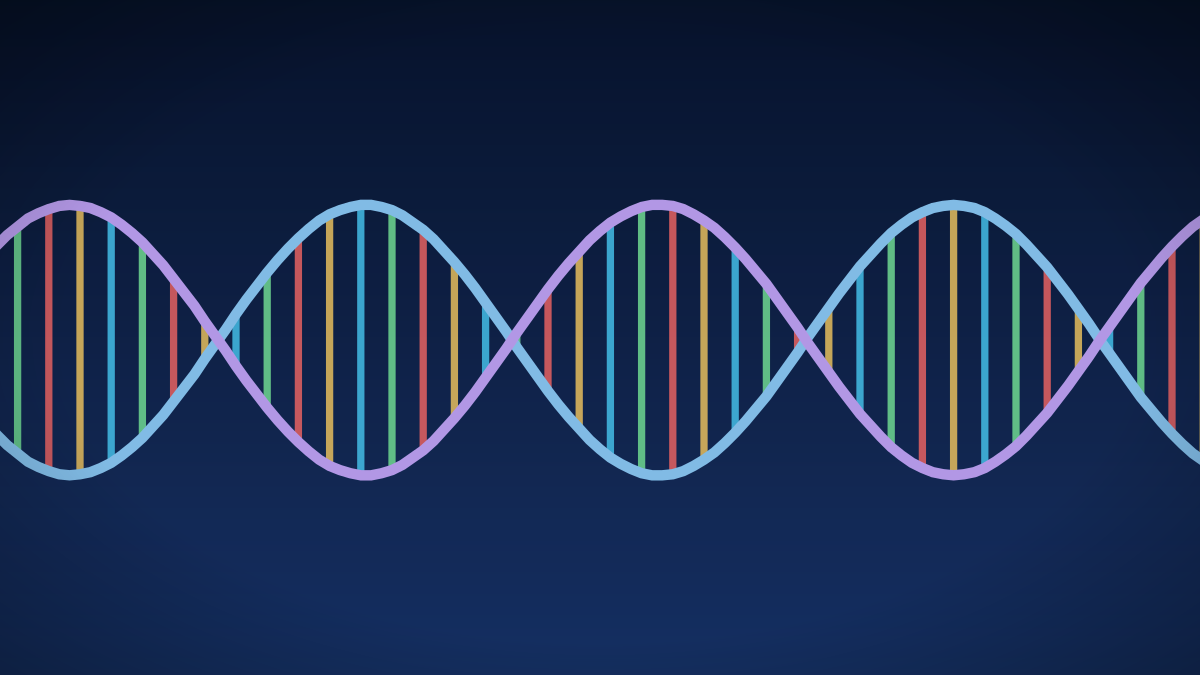
What Is DNA? The Molecule That Carries Your Instructions
DNA is the molecule that carries genetic information. A short guide to its structure and how its letters pair.
What Is a Genome, and What Was the Human Genome Project?
A genome is an organism's complete set of DNA instructions. What that means and how large the human genome is.
References
- BC Ministry of Education and Child Care. Science 10 (curriculum, Content and Elaborations). Accessed October 7, 2026.
- OpenStax. Biology 2e, 14.2 DNA Structure and Sequencing. Accessed October 7, 2026.
- OpenStax. Biology 2e, 14.3 Basics of DNA Replication. Accessed October 7, 2026.
- OpenStax. Biology 2e, 14.4 DNA Replication in Prokaryotes. Accessed October 7, 2026.
- OpenStax. Biology 2e, 10.1 Cell Division. Accessed October 7, 2026.
- OpenStax. Biology 2e, 11.1 The Process of Meiosis. Accessed October 7, 2026.
- OpenStax. Biology 2e, 13.2 Chromosomal Basis of Inherited Disorders. Accessed October 7, 2026.
- MedlinePlus (NIH). What is a gene?. Accessed October 7, 2026.
- MedlinePlus (NIH). What is a chromosome?. Accessed October 7, 2026.
- MedlinePlus (NIH). How many chromosomes do people have?. Accessed October 7, 2026.
These lessons follow the content areas listed in the British Columbia curriculum. They are study material written for this site and are not an official document. The official curriculum is the authority on what each course requires. Lessons are general education, not medical advice.