
Mendelian Genetics, Punnett Squares and Complete Dominance
Mendel's pea experiments, dominant and recessive alleles, monohybrid and dihybrid Punnett squares, test crosses and probability.
🎯 By the end of this lesson
- Describe Mendel's pea experiments and explain why peas were a good choice.
- Define allele, genotype, phenotype, homozygous, heterozygous, dominant and recessive.
- Explain the law of segregation and the law of independent assortment in terms of meiosis.
- Construct a monohybrid Punnett square and state genotype and phenotype ratios and probabilities.
- Use a test cross to determine an unknown genotype.
- Apply the product and sum rules to calculate the chance of combined events.
- Construct and interpret a dihybrid cross with a 9:3:3:1 outcome.
- Calculate the chance of a child inheriting a recessive condition from two carrier parents.
1Overview
Why do children resemble their parents, yet differ from them and from each other? Before DNA was known, an Austrian monk named Gregor Mendel answered much of that question with a garden, a lot of patience, and careful counting. His results still form the basis of the way heredity is taught. This lesson covers Mendelian genetics, Punnett squares and complete dominance, the simplest pattern of inheritance, and applies them to human traits.
2Mendel’s experiments with peas
Johann Gregor Mendel (1822–1884) studied inheritance in garden peas, Pisum sativum. Peas are an excellent choice: they have many easily seen traits with two clear forms (violet or white flowers, round or wrinkled seeds), they grow quickly, and they normally self-fertilize, so they produce true-breeding lines in which every generation shows the same trait. He also could cross-pollinate them by hand to control which plants mated. He presented results from nearly 30,000 plants in 1865, and his work was rediscovered in 1900.
Mendel labelled generations: P for the parent plants, F1 for their offspring and F2 for the offspring produced when F1 plants mated with each other.
The pattern was the same for every trait he tested. When true-breeding violet and white plants were crossed, every F1 plant was violet. The white trait vanished. But when the F1 plants were crossed, white flowers returned in the F2 at about one white for every three violet plants (705 violet and 224 white). The same near-3:1 ratio appeared for other traits:
| Trait (dominant : recessive) | F2 count | Ratio |
|---|---|---|
| Flower position (axial : terminal) | 651 : 207 | 3.14 : 1 |
| Plant height (tall : dwarf) | 787 : 277 | 2.84 : 1 |
| Seed texture (round : wrinkled) | 5,474 : 1,850 | 2.96 : 1 |
| Seed colour (yellow : green) | 6,022 : 2,001 | 3.01 : 1 |
| Pod colour (green : yellow) | 428 : 152 | 2.82 : 1 |
These results contradicted the popular idea of “blending inheritance,” in which offspring would be a mixture of the parents. Traits stayed distinct and could skip a generation. Mendel proposed that inheritance depends on units that come in pairs (now called genes with two alleles), that each parent passes on one unit of each pair, and that one form can hide the other.
3The vocabulary of inheritance
| Term | Meaning | Example |
|---|---|---|
| Allele | One version of a gene | B (violet) and b (white) |
| Dominant allele | Shows its effect when at least one copy is present; written as a capital letter | B |
| Recessive allele | Shows its effect only when no dominant allele is present; written as a lower-case letter | b |
| Genotype | The alleles an individual carries | BB, Bb or bb |
| Phenotype | The observable trait | violet or white flowers |
| Homozygous | Two identical alleles | BB or bb |
| Heterozygous | Two different alleles | Bb |
With complete dominance, a heterozygous individual (Bb) has the same phenotype as a homozygous dominant individual (BB). “Homozygous dominant and heterozygous organisms will look identical.” This is why a hidden recessive allele can pass silently through a generation, and why the white trait could reappear in the F2.
Dominant does not mean “better,” “stronger” or “more common.” It only describes which allele is expressed when two different alleles are present. Some dominant alleles are rare, and some are harmful. Huntington’s disease, for example, is caused by a dominant allele, while the allele for normal function is recessive.
4The law of segregation
Mendel’s first principle is the law of segregation: the two alleles of a gene separate (segregate) during the formation of gametes, so each gamete carries only one allele of each gene. Fertilization then restores the pair. The physical basis is meiosis. In the first meiotic division, homologous chromosomes are pulled apart, and with them the two alleles of each gene. An individual with the genotype Bb produces two kinds of gametes, half with B and half with b.
In the F1 plants of Mendel’s cross (all Bb), each plant makes B and b gametes in equal numbers. Random fertilization of those gametes gives the F2 a mix of genotypes, and a mix of phenotypes in a 3:1 ratio.
5Using a Punnett square
A Punnett square is a grid that shows all possible combinations of gametes from two parents. The steps are:
- Write the genotype of each parent.
- List the gametes each parent can make (one allele each).
- Put one parent’s gametes along the top and the other’s down the side.
- Fill each box with the allele from its column and the allele from its row.
- Count the genotypes and phenotypes and convert them to ratios or probabilities.
For the cross Bb × Bb, the genotype ratio is 1 BB : 2 Bb : 1 bb, and the phenotype ratio is 3 dominant : 1 recessive. Each box has the same chance (one in four) because each gamete type is equally likely and fertilization is random.
In pea plants, yellow seeds (Y) are dominant to green seeds (y). A heterozygous yellow plant (Yy) is crossed with a green plant (yy). Gametes: Yy makes Y and y; yy makes only y. The four boxes are Yy, yy, Yy, yy. The genotype ratio is 1 Yy : 1 yy, and the phenotype ratio is 1 yellow : 1 green. The probability of a green offspring is 1/2.
The test cross
An organism with a dominant phenotype may be homozygous (BB) or heterozygous (Bb), and it is impossible to tell by looking. The solution is a test cross: the unknown individual is crossed with a homozygous recessive individual (bb). If all offspring show the dominant trait, the unknown parent is homozygous dominant. If the offspring appear in a 1:1 ratio of dominant to recessive, the unknown parent is heterozygous. Animal and plant breeders use this method to find out which individuals carry a hidden recessive allele.
6Probability: why ratios are not guarantees
A Punnett square gives probabilities, not promises. Each fertilization is an independent event, like a coin toss. A couple whose chance of having a child with a recessive condition is 1 in 4 can have four children with none affected, or two affected children in a row. Ratios only become close to the predicted values in large samples, which is why Mendel counted thousands of plants.
Two rules make it possible to calculate the chance of combined events.
- Product rule. The chance that two independent events both occur is the product of their separate chances.
- Sum rule. The chance that either one of two mutually exclusive events occurs is the sum of their chances.
Two carriers of cystic fibrosis (Cc × Cc) have a child. The chance of an affected child (cc) is 1/4. The chance that the next two children are both affected is 1/4 × 1/4 = 1/16, using the product rule. The chance that a child is unaffected is the sum of the chances of CC (1/4) and Cc (1/2), which is 3/4.
7Two traits at once: the dihybrid cross and independent assortment
Mendel also followed two traits together, such as seed colour and seed shape. He crossed plants that were heterozygous for both traits (YyRr × YyRr). Each parent can produce four types of gametes (YR, Yr, yR and yr), so the Punnett square has 16 boxes, and the phenotypes appear in the ratio 9 : 3 : 3 : 1.
In one experiment with tall and inflated-pod peas, the counts were 2,706 tall and inflated, 930 tall and constricted, 888 dwarf and inflated and 300 dwarf and constricted, which is close to 9:3:3:1. The same result follows from multiplying probabilities: the chance of round and yellow is 3/4 × 3/4 = 9/16, and the chance of wrinkled and green is 1/4 × 1/4 = 1/16.
This outcome illustrates Mendel’s second principle, the law of independent assortment: alleles of different genes sort into gametes independently of each other. The physical basis is that homologous pairs line up independently of one another in the first division of meiosis. There is an important limit: genes that lie close together on the same chromosome tend to be inherited together (they are linked), and this departs from independent assortment. Crossing over can still separate them, and the less often it happens, the closer the genes are.
Mendel’s two principles come from meiosis. Segregation: the two alleles of a gene separate into different gametes. Independent assortment: alleles of genes on different chromosomes are distributed to gametes independently. Together with random fertilization, these explain why siblings differ.
8Mendelian inheritance in human conditions
Many human traits and disorders follow Mendel’s patterns. A recessive condition appears only in people who inherit two altered copies, and a person with one altered copy is a carrier, who usually shows no symptoms but can pass the altered copy on. Autosomal dominant conditions, such as Huntington’s disease and Marfan syndrome, need only one altered copy.
- Cystic fibrosis is recessive. When both parents are carriers, each child has a 25 percent chance of having cystic fibrosis, a 50 percent chance of being a carrier, and a 25 percent chance of neither.
- Sickle cell disease is also recessive. When both parents are carriers, each child has a 1 in 4 chance of inheriting no sickle cell gene, a 1 in 2 chance of being a carrier, and a 1 in 4 chance of the disease.
- PKU, covered in the previous lesson, is recessive as well, and parents are usually carriers who are unaware of it.
A genetic counsellor uses exactly these ideas. If a couple learns that both are carriers of a recessive condition, a Punnett square gives the chance for each pregnancy, and the same 1 in 4 risk applies every time because each pregnancy is independent. Testing and counselling help families understand the options. More on blood-group inheritance is in What are blood types?.
Not every pattern is this simple. The next lesson covers incomplete dominance, co-dominance, multiple alleles and sex-linked inheritance, and shows how pedigrees are used to trace human traits through families.
9Practice problems with solutions
Problem 1: reading offspring ratios
A plant with purple flowers (dominant, P) is crossed with a plant with white flowers. Of 80 offspring, 41 are purple and 39 are white. What is the genotype of the purple parent?
Solution. The white parent must be pp. Offspring are about half purple and half white, which is the 1:1 result of a test cross with a heterozygote. The purple parent is Pp. If it were PP, all 80 offspring would be purple.
Problem 2: probability of several children
Two carriers of sickle cell disease plan three children. What is the chance that all three have the disease? Each child has a 1/4 chance, and the births are independent, so the product rule gives 1/4 × 1/4 × 1/4 = 1/64. The chance that none has the disease is (3/4)3 = 27/64.
Problem 3: a dihybrid shortcut
In a cross of YyRr × YyRr, what fraction of offspring are wrinkled and yellow (rr and at least one Y)? The chance of wrinkled is 1/4 and the chance of yellow is 3/4, so the product is 3/16, matching the 3 in the 9:3:3:1 ratio.
Summary
- Alleles separate into different gametes (segregation) and genes on different chromosomes sort independently.
- With complete dominance, heterozygous and homozygous dominant individuals look the same, so a test cross is needed to tell them apart.
- Punnett squares give probabilities for each birth, not guarantees for a small family.
🔑Key terms
?Quick check
Try each question first, then reveal the answer.
1. Why did every F1 plant in Mendel's violet x white cross have violet flowers?
Violet is dominant. Each F1 plant received one violet allele and one white allele, and the dominant violet allele is expressed while the recessive white allele is hidden.
2. Cross two heterozygous tall plants (Tt x Tt). Give the genotype ratio, phenotype ratio and the probability of a short plant.
The genotype ratio is 1 TT : 2 Tt : 1 tt, the phenotype ratio is 3 tall : 1 short, and the probability of a short plant (tt) is 1/4.
3. A purple-flowered pea plant is crossed with a white-flowered plant, and about half the offspring are white. What is the genotype of the purple parent?
The purple parent is heterozygous (Pp). A homozygous purple parent would give all purple offspring when crossed with white (pp).
4. Explain how meiosis accounts for the law of segregation.
In the first division of meiosis homologous chromosomes separate, so the two alleles of a gene go to different gametes and each gamete receives only one allele.
5. What are the gametes of a YyRr individual, and how many boxes does the Punnett square have for YyRr x YyRr?
The gametes are YR, Yr, yR and yr. Each parent makes four types, so the square has 4 x 4 = 16 boxes.
6. Two carriers of sickle cell disease have a child. State the chance that the child has the disease, is a carrier, and is unaffected and not a carrier.
The chance of the disease is 1 in 4, of being a carrier 1 in 2, and of being neither 1 in 4.
7. A couple who are both carriers of cystic fibrosis already have one affected child. What is the chance that their next child is also affected, and why?
The chance is still 1/4. Each pregnancy is an independent event, so earlier children do not change the probability.
8. Why might the ratio in a real breeding experiment with 20 offspring differ from the 3:1 ratio predicted by a Punnett square?
Fertilization is random, so small samples show chance deviations. Ratios approach the predicted values only in large samples, which is why Mendel counted thousands of plants.
BC curriculum content covered in this lesson
- Patterns of inheritance: Mendelian genetics
- Patterns of inheritance: Punnett squares
- Patterns of inheritance: complete dominance
- Patterns of inheritance: human genetics (autosomal recessive and dominant examples)
Related articles
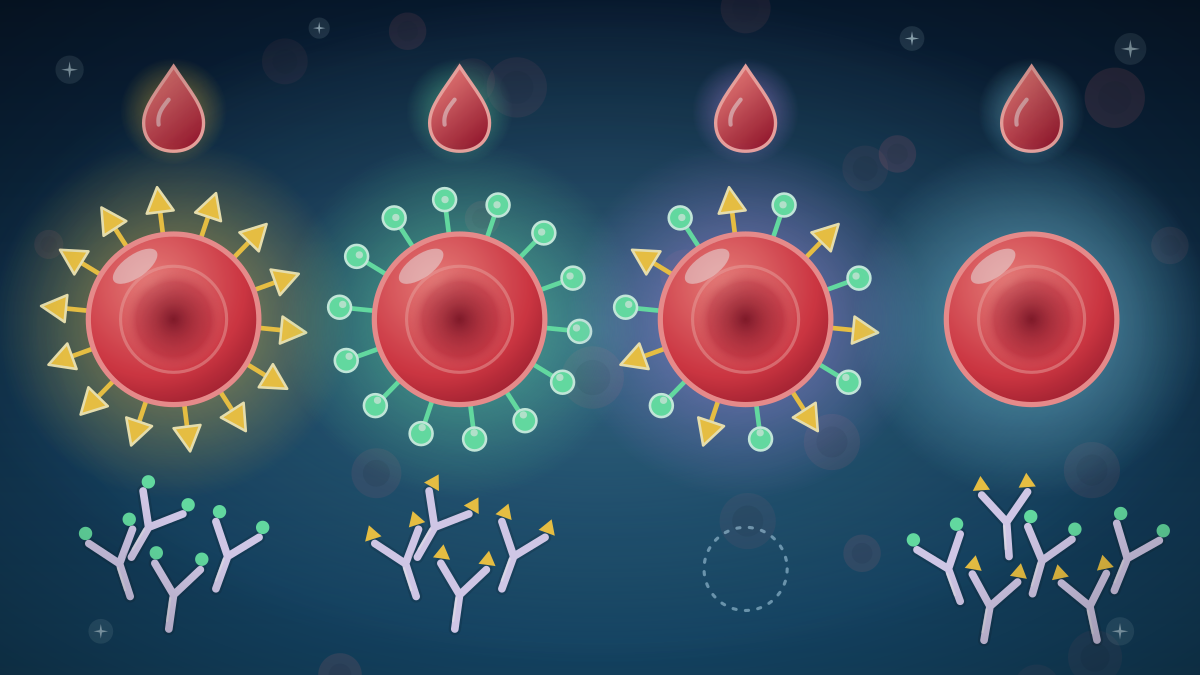
What Are Blood Types and Why Do They Matter?
Blood types come from inherited antigens on red cells. ABO and Rh groups decide which transfusions are safe and matter in pregnancy. How the groups were found and how common each is.
What Is DNA? The Molecule That Carries Your Instructions
DNA is the molecule that carries genetic information. A short guide to its structure and how its letters pair.
References
- BC Ministry of Education and Child Care. Science 10 (curriculum, Content and Elaborations). Accessed October 7, 2026.
- OpenStax. Biology 2e, 12.1 Mendel's Experiments and the Laws of Probability. Accessed October 7, 2026.
- OpenStax. Biology 2e, 12.2 Characteristics and Traits. Accessed October 7, 2026.
- OpenStax. Biology 2e, 12.3 Laws of Inheritance. Accessed October 7, 2026.
- OpenStax. Biology 2e, 13.1 Chromosomal Theory and Genetic Linkage. Accessed October 7, 2026.
- OpenStax. Biology 2e, 11.1 The Process of Meiosis. Accessed October 7, 2026.
- MedlinePlus (NIH). Inheritance patterns. Accessed October 7, 2026.
- NHS. Cystic fibrosis: causes. Accessed October 7, 2026.
- NHS. Sickle cell disease: causes. Accessed October 7, 2026.
These lessons follow the content areas listed in the British Columbia curriculum. They are study material written for this site and are not an official document. The official curriculum is the authority on what each course requires. Lessons are general education, not medical advice.