
Incomplete Dominance, Co-dominance, Sex-Linkage and Human Genetics
Inheritance patterns beyond complete dominance: intermediate and co-dominant traits, ABO blood groups, X-linked traits and pedigrees.
🎯 By the end of this lesson
- Distinguish complete dominance, incomplete dominance and co-dominance using phenotypes of heterozygotes.
- Predict offspring ratios for an incomplete dominance cross using a Punnett square.
- Determine possible ABO genotypes and offspring blood types for given parents.
- Explain how sex is determined and why X-linked recessive traits are more common in males.
- Use a Punnett square to predict the outcome of an X-linked cross.
- Interpret a simple pedigree to infer whether a trait is dominant or recessive.
- Compare the main patterns of human inheritance with examples.
1Overview
Mendel’s peas were an ideal first case: one gene, two alleles, and a dominant allele that always hid the recessive one. Real inheritance is richer. A pink flower has a red parent and a white parent. A person can belong to blood type AB. Some conditions affect sons far more often than daughters. This lesson covers the remaining patterns in the official content: incomplete dominance, co-dominance, sex-linked inheritance, and human genetics more generally, including how pedigrees are used to follow traits through families.
2Incomplete dominance: a blend that is not really a blend
In incomplete dominance, the heterozygote shows a trait between those of the two homozygotes, because neither allele completely masks the other. The classic example is the four-o’clock flower. Crossing a red-flowered plant with a white-flowered plant produces pink offspring. Crossing those pink plants with each other gives red, pink and white flowers in the next generation.
This pattern might look like the old idea of blending inheritance, in which parental traits dissolve into a mixture. It is not blending, because the red and white alleles are not lost: they re-emerge unchanged in the next generation. The pink colour is the way a single dose of the red allele appears. A likely molecular explanation is that one functional copy of a gene makes about half as much pigment as two copies do, though the exact mechanism depends on the trait.
Two pink four-o’clock plants (RW × RW) are crossed and produce 200 seeds that all germinate. Expected result: 1/4 red (RR) = 50 plants, 1/2 pink (RW) = 100 plants, 1/4 white (WW) = 50 plants. Notice that the phenotype ratio is 1 : 2 : 1, the same as the genotype ratio. In complete dominance the phenotype ratio would have been 3 : 1 because the heterozygotes could not be told apart from the homozygous dominant plants.
3Co-dominance: both alleles show
In co-dominance, both alleles are expressed to an equal degree in the heterozygote, so both traits appear together instead of blending. In roan cattle, an animal that carries an allele for red coat and an allele for white coat has a coat with both red and white hairs mixed together. It is neither pink nor red.
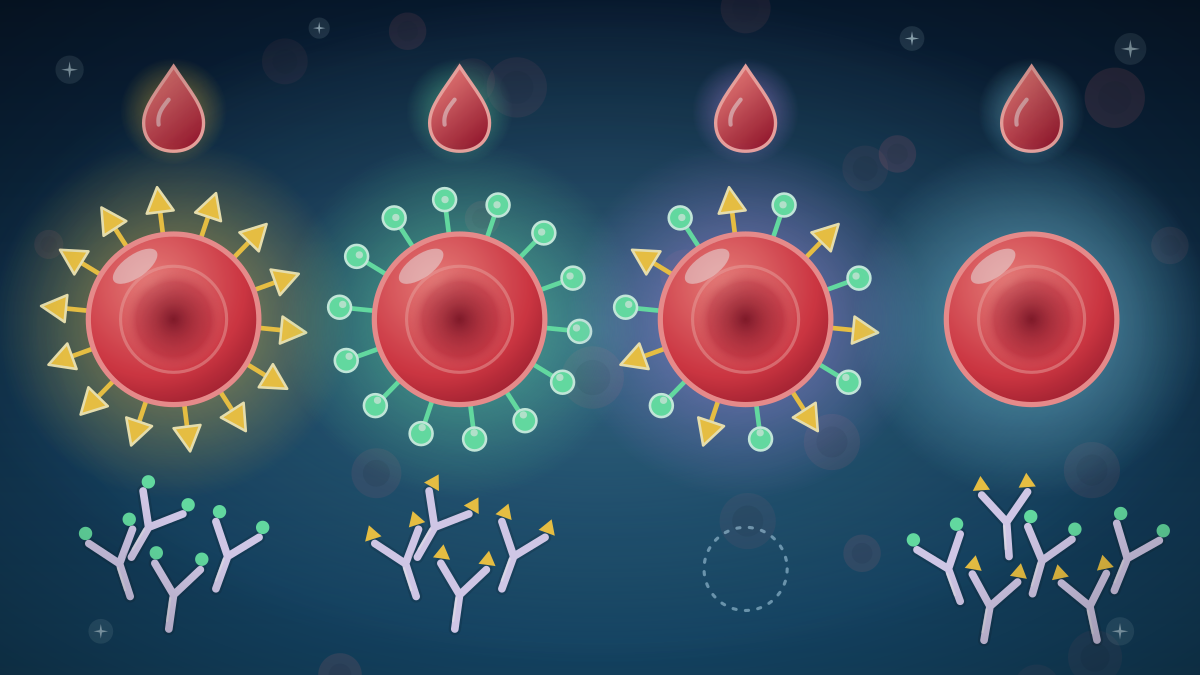
The human ABO blood group is a well-known co-dominant example. A person who inherits an A allele from one parent and a B allele from the other has type AB blood, with both A and B markers (antigens) on the surface of the red blood cells.
| Pattern | Heterozygote phenotype | Example |
|---|---|---|
| Complete dominance | Looks like the dominant homozygote | Violet (Bb) peas look like BB |
| Incomplete dominance | Intermediate between the two homozygotes | Red × white four-o’clocks give pink |
| Co-dominance | Both traits fully expressed | Roan cattle; AB blood type |
Co-dominance and incomplete dominance are often confused. In incomplete dominance the heterozygote has a new, in-between phenotype (pink). In co-dominance the heterozygote shows both parental traits at once and separately (red hairs and white hairs, or both A and B markers).
4Multiple alleles and the ABO system
A population can have more than two alleles of a gene, although any one person carries only two. The ABO blood group is controlled by one gene with three common alleles, usually written IA, IB and i. Blood is classified by the presence or absence of antigens A and B on red blood cells, giving four blood types: A, B, AB and O.
Alleles IA and IB are co-dominant to each other, and both are dominant to i. As a result, a person of type A can have the genotype IAIA or IAi, and a person of type O must be ii. The article What are blood types? explains why blood type matters for transfusions.
A parent with type A blood (genotype IAi) and a parent with type B blood (genotype IBi) have a child. Gametes: the first parent makes IA and i; the second makes IB and i. The four boxes are IAIB (AB), IAi (A), IBi (B) and ii (O). Each blood type has a 1 in 4 chance, so two parents with type A and type B can have a child of any of the four types.
5Sex determination and sex-linked inheritance
Humans have 23 pairs of chromosomes, 22 pairs of autosomes and one pair of sex chromosomes. Females have two X chromosomes (XX). Males have one X and one Y (XY). Every egg carries an X, while a sperm carries either an X or a Y, so the sperm determines the sex of the child with an approximate 50:50 chance.
A gene on a sex chromosome shows sex-linked inheritance. In practice this mostly means genes on the X chromosome, because the X is much larger than the Y and carries many more genes. Thomas Hunt Morgan’s work with fruit flies provided key evidence that genes are on chromosomes, through a trait that segregated together with the X chromosome.
X-linked recessive traits
Males have only one X chromosome, so a single recessive allele on the X is enough to produce the trait. Females have two X chromosomes, so they must inherit two copies of the allele to be affected, and females with one copy are usually carriers. The consequences are:
- X-linked recessive conditions are much more common in males than in females.
- Fathers cannot pass an X-linked trait to their sons, because sons receive the Y from their father.
- An affected father passes his X to all of his daughters, who become carriers.
Red-green colour vision deficiency is an example. In populations of Northern European ancestry it occurs in about 1 in 12 males and about 1 in 200 females. The genes involved (OPN1LW and OPN1MW) lie on the X chromosome and make the light-sensing cone proteins needed to tell red from green. Hemophilia A and B are other X-linked recessive conditions, caused by variants in the F8 and F9 genes that make blood-clotting factors. Hemophilia A affects about 1 in 4,000 to 1 in 5,000 males.
A woman who is a carrier of colour vision deficiency (XCXc) and a man with normal colour vision (XCY) have children. The eggs are XC and Xc; the sperm are XC and Y. The four combinations are XCXC (unaffected daughter), XCXc (carrier daughter), XCY (unaffected son) and XcY (affected son). Each son has a 1/2 chance of being affected, and no daughter is affected.
Other sex-related patterns exist. X-linked dominant conditions affect males and females, although females often have milder symptoms. Fragile X syndrome is an example. Y-linked traits pass only from father to son. Why females with one altered X are often unaffected relates to X inactivation, an epigenetic process that silences one X chromosome in each cell. If the normal X happens to be silenced in more than half of cells, a carrier may show mild symptoms.
6Human genetics: tracing traits through families
People cannot be crossed in an experiment, so human inheritance is studied by looking at families. A pedigree is a chart that diagrams the inheritance of a trait or health condition through generations of a family. Squares represent males, circles represent females, and filled symbols represent individuals who have the trait. A horizontal line joins partners and a vertical line leads to their children.
Reading a pedigree involves logic that matches Mendel’s rules:
- Look for unaffected parents with an affected child. This indicates a recessive trait, and both parents must be carriers.
- Look at who is affected. If males are affected far more than females, an X-linked recessive pattern is likely.
- Check whether affected fathers have affected sons. If so, X-linked inheritance is ruled out.
- Look for the trait in every generation. A dominant trait usually appears in each generation, while a recessive trait often skips generations.
| Pattern | Key feature | Example |
|---|---|---|
| Autosomal dominant | One altered copy is enough | Huntington’s disease, Marfan syndrome |
| Autosomal recessive | Two altered copies needed; parents usually carriers | Cystic fibrosis, sickle cell disease |
| X-linked recessive | More males affected; no father-to-son transmission | Hemophilia, red-green colour vision deficiency |
| X-linked dominant | Males and females affected; no father-to-son transmission | Fragile X syndrome |
| Y-linked | Father to son only | Some forms of Y chromosome infertility |
| Co-dominant | Both alleles expressed | ABO blood group |
| Mitochondrial | Passed only by mothers, because egg cells supply mitochondria | Leber hereditary optic neuropathy |
Whether a trait is dominant, recessive, co-dominant or sex-linked describes how its alleles are passed on and expressed. A pedigree and a Punnett square work together: the pedigree suggests the pattern, and the Punnett square predicts the chance for the next child.
Many human characteristics do not follow these single-gene patterns. Traits such as height, and conditions such as heart disease, type 2 diabetes and schizophrenia, involve multiple genes and gene-environment interactions. Chromosomal conditions such as Down syndrome follow different rules, as the first lesson explained. Genetic testing is voluntary, and a geneticist or genetic counsellor can explain what a test can and cannot show.
Hemophilia illustrates a family pattern. Because the genes lie on the X chromosome, a woman with one altered copy is usually a carrier whose blood still clots normally in most cases, since about half the factor level is generally enough. Her sons each have a 1 in 2 chance of being affected. Families affected by such conditions use pedigrees and genetic testing to understand risks before and during pregnancy.
The next lesson moves from how alleles are passed on to how new alleles arise in the first place: mutation.
7Practice problems with solutions
Problem 1: choosing the pattern
A plant species has red, pink and white flowers. A student crosses two pink plants and gets 26 red, 49 pink and 25 white. Which pattern is shown? The ratio is close to 1:2:1 with three phenotypes, and the heterozygote is intermediate, so it is incomplete dominance. If the heterozygote had shown red and white patches together, co-dominance would be the better description.
Problem 2: blood types
A man with type AB and a woman with type O have a child. The man makes IA and IB gametes and the woman makes only i. Children are IAi (type A) or IBi (type B), each with a probability of 1/2. A child of type O or AB is not possible.
Problem 3: X-linked condition
A man with hemophilia and a woman who is not a carrier have children. All daughters receive the father’s X with the allele and are carriers, and none is affected. All sons receive the father’s Y and the mother’s normal X, so none is affected.
Summary table
| If the data show | Think |
|---|---|
| 3:1 phenotypes, heterozygote looks dominant | Complete dominance |
| 1:2:1 phenotypes with an intermediate type | Incomplete dominance |
| Both parental traits visible in the heterozygote | Co-dominance |
| More affected males, none from father to son | X-linked recessive |
Using a pedigree to calculate risk
If a pedigree shows that a recessive condition appears in a family, a person with an affected sibling and unaffected parents has a 2 in 3 chance of being a carrier. This is because the unaffected person is one of three outcomes (1 AA : 2 Aa) from two carrier parents, and the affected aa outcome has been ruled out. This type of reasoning is routine in genetic counselling.
🔑Key terms
?Quick check
Try each question first, then reveal the answer.
1. A red snapdragon-like flower (RR) is crossed with a white one (WW) and the offspring are pink. What pattern of inheritance is this, and what is the expected result of crossing two pink plants?
This is incomplete dominance. Crossing two pink (RW) plants gives 1/4 red, 1/2 pink and 1/4 white.
2. How does co-dominance differ from incomplete dominance?
In co-dominance both alleles are fully expressed and both traits appear (such as red and white hairs), while in incomplete dominance the heterozygote has a blended, intermediate phenotype.
3. A woman with type O blood and a man with type AB blood have a child. List the possible blood types of the child.
The woman is ii and the man is IAIB, so the children are IAi (type A) or IBi (type B). Type AB and type O are not possible.
4. Why can two parents with type A blood have a child with type O?
Both parents can be IAi. Each can pass on the recessive i allele, and a child who receives i from both is ii, which is type O.
5. Explain why X-linked recessive conditions such as hemophilia are more common in males than in females.
Males have one X chromosome, so one recessive allele produces the condition. Females have two X chromosomes and need two copies of the allele to be affected.
6. A father has an X-linked recessive condition and the mother is not a carrier. What are the chances that their sons and daughters are affected or carriers?
No son is affected, because sons receive the father's Y. All daughters receive the father's X with the allele and are carriers.
7. In a pedigree, two unaffected parents have an affected daughter. What does this reveal about the trait and the parents?
The trait is recessive, and an affected daughter indicates it is autosomal. Both parents must be carriers (heterozygous).
8. Why is a pedigree useful in human genetics when experimental crosses are not possible?
A pedigree shows how a trait appears across generations of a family, which allows the likely pattern of inheritance to be inferred and the risk for future children to be estimated.
BC curriculum content covered in this lesson
- Patterns of inheritance: incomplete dominance
- Patterns of inheritance: co-dominance
- Patterns of inheritance: sex-linked inheritance
- Patterns of inheritance: human genetics
Related articles
What Are Blood Types and Why Do They Matter?
Blood types come from inherited antigens on red cells. ABO and Rh groups decide which transfusions are safe and matter in pregnancy. How the groups were found and how common each is.
What Is DNA? The Molecule That Carries Your Instructions
DNA is the molecule that carries genetic information. A short guide to its structure and how its letters pair.
References
- BC Ministry of Education and Child Care. Science 10 (curriculum, Content and Elaborations). Accessed October 7, 2026.
- Encyclopaedia Britannica. Incomplete dominance. Accessed October 7, 2026.
- Encyclopaedia Britannica. Codominance. Accessed October 7, 2026.
- Encyclopaedia Britannica. ABO blood group system. Accessed October 7, 2026.
- OpenStax. Biology 2e, 13.1 Chromosomal Theory and Genetic Linkage. Accessed October 7, 2026.
- MedlinePlus (NIH). Inheritance patterns. Accessed October 7, 2026.
- MedlinePlus (NIH). Red-green color vision deficiency. Accessed October 7, 2026.
- MedlinePlus (NIH). Hemophilia. Accessed October 7, 2026.
- MedlinePlus (NIH). How many chromosomes do people have?. Accessed October 7, 2026.
- NHGRI. Pedigree (Talking Glossary). Accessed October 7, 2026.
- MedlinePlus (NIH). Genetic testing. Accessed October 7, 2026.
These lessons follow the content areas listed in the British Columbia curriculum. They are study material written for this site and are not an official document. The official curriculum is the authority on what each course requires. Lessons are general education, not medical advice.