
Levels of Organization and Interrelationships
From molecules to ecosystems: the nine levels of life, plus First Peoples understandings of plants as timing indicators and decaying animals as plant nutrients.
🎯 By the end of this lesson
- Arrange the nine levels of organization in order from molecular to ecosystem and give an example of each.
- Explain what is meant by an emergent property using an example from two different levels.
- Distinguish a population from a community and an ecosystem.
- Trace a cause, such as a gene change, upward through several levels of organization.
- Describe how salmonberry and spawning salmon illustrate plants as timing indicators and decaying animals as plant nutrients.
- Explain how clam gardens show human stewardship that changes an ecosystem.
- Match a research question to the level of organization at which it is best studied.
1Overview
A single salmon moving up a river looks like one thing. In reality it is a crowd: trillions of cells, thousands of kinds of molecules, a dozen organ systems, and a long list of other species depending on its body. Biology makes sense of this crowd by sorting it into layers. Each layer is built from the one below, yet each behaves in ways the lower layer never could. How does a pile of chemicals become a fish, and how does a fish become part of a forest?
2The nine levels of organization
Biologists describe levels of organization, a ladder running from the very small to the very large. For this course the official list has nine rungs: molecular, cellular, tissue, organ, organ system, organism, population, community, and ecosystem. Larger still is the biosphere, the collection of all ecosystems on Earth, but the course list stops at the ecosystem.
Working upward
- Molecular. Atoms join into molecules. Large molecules such as proteins, carbohydrates, lipids and DNA are the working parts of life.
- Cellular. The cell is the smallest unit that carries out all the activities of life. Molecules are organized inside a membrane-bound package.
- Tissue. A tissue is a group of similar cells that perform a related function, such as muscle tissue or skin tissue.
- Organ. An organ is a collection of tissues that perform a common function. The stomach is an example.
- Organ system. Organs that work together form an organ system. The heart and blood vessels make up the circulatory system, which moves blood.
- Organism. One complete living individual, built of cooperating organ systems (or, in many species, of a single cell).
- Population. All the individuals of one species living in the same area at the same time, such as all the pine trees in one forest.
- Community. All the populations of different species living in an area.
- Ecosystem. The community together with its non-living surroundings, such as soil nutrients, water and sunlight.
Each level has emergent properties: abilities that appear only when the parts are organized together. A single heart muscle cell can contract, but only a whole heart, with valves and chambers, can pump blood in one direction. A single wolf cannot be a "population", and a single species cannot be a "community".
Why organization matters: structure fits function
The pattern repeating at every level is that structure fits function. Red blood cells have a flattened shape that suits carrying oxygen. Lung tissue is thin and folded, which suits gas exchange. A stack of leaf cells packed with chloroplasts suits capturing sunlight. When a biologist sees an unfamiliar structure, asking what job it does is almost always a good first question.
The levels also explain how disease and damage spread. A mutation is a change at the molecular level, yet it can alter a protein, a cell, a tissue and eventually the whole organism. A new disease in a population can change the community around it. Following a cause up or down the ladder is one of the main skills in biology.
Moving between levels: an example
- A change in the gene for the protein hemoglobin alters its molecular shape (molecular level).
- Red blood cells carrying the changed protein have a different shape (cellular).
- Blood tissue carries less oxygen efficiently (tissue).
- Organs such as muscles receive less oxygen and tire sooner (organ, organ system).
- The affected individual has reduced stamina (organism).
- If the change is common in a population, it can influence how that population responds to disease or environment (population).
A "population" is not simply "a lot of animals". It is the members of one species in one area. Salmon and bears in the same river are two populations, and together with the trees, insects and fungi they form a community.
3Population, community and ecosystem: the ecological levels
The top three rungs shift attention from bodies to relationships. Population ecology asks how many individuals there are and why that number changes. Community ecology asks which species live together and how they affect one another: who eats whom, who competes, who cooperates. Ecosystem ecology adds the non-living world, tracking how energy and matter such as carbon and nitrogen move between organisms and their surroundings. See also the article on what an ecosystem is.
Removing one population can ripple through a whole community. When a top predator disappears from an ecosystem, the animals it ate can multiply, overgraze plants and change the landscape. This is why wildlife managers study communities and not only individual species.
4What counts as a living organism
The organism level raises a basic question: what makes something alive? Textbooks list several shared properties of life rather than a single test. Living things show order (highly organized structures made of one or more cells), sensitivity to stimuli (a plant bends toward light; bacteria move toward or away from chemicals), reproduction, adaptation to the environment produced by natural selection, growth and development directed by genes, regulation of the internal environment (homeostasis), energy processing, and evolution of populations over time.
These properties connect directly to the levels. Order is the levels themselves. Energy processing happens inside cells, in organelles such as mitochondria and chloroplasts. Reproduction and evolution act on populations. No single property is enough: a flame grows and uses energy, yet it has no cells, no genes and no way to adapt.
An organism is not always a large, many-celled animal or plant. A single bacterium is a complete organism, and so is a single-celled yeast. The same ladder applies, but the cellular and organism levels are one and the same for these species. The next lessons return to this when comparing single-celled and multi-celled life.
Why a hierarchy helps
Sorting life into a hierarchy gives a shared vocabulary. A researcher in Vancouver and one in Halifax both know that "a population" means one species in one area. The vocabulary also reveals what to measure: genes and proteins at the molecular level, cell counts at the cellular level, birth and death rates at the population level, and energy flow at the ecosystem level.
Questions that look unrelated, such as "why do some fish die after spawning?" and "why is a berry bush thick near a stream?", often turn out to be about the same chain of causes seen from different levels.
5First Peoples understandings of interrelationships between organisms
First Peoples in British Columbia have lived within, and carefully observed, these ecological relationships for thousands of years. The BC curriculum includes two linked examples: plants as indicators of the timing of corresponding events, and decaying animals as plant nutrients. These are knowledge systems with their own methods, held and taught by Nations and Elders. The summaries below describe examples reported in published sources and do not stand in for teaching from a local Nation.
Plants as timing indicators
Many Indigenous knowledge systems read the land like a calendar. Plant life cycles and flowering show when other events are due. One widely cited example comes from Heiltsuk (Haíɫzaqv) territory on the central coast: the salmonberry. Children learn early that the salmonberry crop is linked to the coming salmon season. A strong berry crop is taken as a sign of a good salmon run, and a weak crop signals that families should plan more on other foods for winter stores. Other cues are read alongside plants, such as snow patches on the mountains and the numbers of certain birds, to judge when clams are ready to dig or roots ready to harvest.
Modern science can ask why such a link might exist. Plants and animals both respond to the same seasonal cues, such as temperature and day length, so plant timing really can track the timing of other events. This is the same idea used in the scientific study of phenology, the timing of seasonal events in living things.
Decaying animals as plant nutrients
Spawning salmon die in the streams where they hatched, and their bodies break down. Decomposers, including bacteria and fungi, return the nutrients in the carcasses to the soil and water, and plants take them up. The Heiltsuk article above reports that once the salmon arrive, their remains feed the berry bushes, and that a published study drawing on Haíɫzaqv knowledge found more spawning salmon in one season meant more salmonberries per bush the next season. People have also fertilized berry patches with salmon remains, kelp, wood ash and crushed shell, which links the health of the bushes to the care of the salmon.
Both examples describe interdependence: plants signal the timing of events elsewhere in the ecosystem, and the bodies of one species become the nutrients for another. This matches the scientific idea of nutrient cycling, and it also reflects long-term observation and stewardship by First Peoples.
6Stewardship in action: clam gardens
Another BC example of people working with an ecosystem is the clam garden. Coastal First Nations built rock-walled terraces in the low intertidal zone. Sediment accumulates behind the walls, and clearing cobbles from the beach also creates habitat for clams. Researchers working with coastal communities on Quadra Island found that clam gardens held more clams, by number, size and weight, than nearby unwalled beaches, and the oldest gardens found so far date to at least 1,600 years ago.
A clam garden is a population-level and ecosystem-level idea at once: the clam population increases because people modified part of the physical environment. It shows that human communities can be part of an ecosystem rather than separate from it.
Question: Place each item at the correct level of organization: (a) all the Pacific salmon spawning in one stream, (b) a stream with its salmon, bears, trees and water, (c) the heart of one salmon, (d) the hemoglobin protein in a red blood cell, (e) all species living in the stream valley.
Answer: (a) population, because it is one species in one area. (b) ecosystem, because non-living water is included with the living members. (c) organ. (d) molecular. (e) community, because many species are listed but non-living factors are not.
Reading and using the levels
Biologists choose the level that fits the question. A study of how a drug works begins at the molecular level. A study of why cancer spreads may need the cellular and tissue levels. A study of why a river's fish are declining may need population, community and ecosystem levels all at once, and may also draw on the traditional knowledge of the people who have fished it for generations.
| Level | Example | Typical question |
|---|---|---|
| Molecular | DNA, enzymes | How does this enzyme speed up a reaction? |
| Cellular | Neuron | How does a nerve cell send a signal? |
| Tissue / organ | Heart muscle, heart | How does the tissue produce a heartbeat? |
| Organ system | Digestive system | How do organs cooperate to absorb nutrients? |
| Organism | A salmon | How does the body survive the move from sea to river? |
| Population | Salmon in one river | Why did numbers fall this decade? |
| Community | All species in the watershed | What does the loss of salmon do to bears and trees? |
| Ecosystem | Watershed including soil and water | How do nutrients move from ocean to forest? |
Salmon move nutrients from the ocean into forests. Because the same river supports the fish, the bears, the berry bushes and the people who harvest them, a decision about one (a dam, a logging road, a fishing quota) affects all the levels. Careful management uses knowledge from both scientific research and First Peoples traditions.
7Summary
- Life is organized in levels: molecular, cellular, tissue, organ, organ system, organism, population, community and ecosystem.
- Each level is built from the one below and shows emergent properties.
- Structure fits function at every level.
- Populations are one species in one area; communities are all populations; ecosystems add non-living factors.
- First Peoples knowledge records plants as timing indicators and decaying animals as plant nutrients, as in the Heiltsuk salmonberry and salmon relationship.
- Clam gardens show long-term stewardship that increased the productivity of an ecosystem.
🔑Key terms
?Quick check
Try each question first, then reveal the answer.
1. List the nine levels of organization in order from smallest to largest.
Molecular, cellular, tissue, organ, organ system, organism, population, community, ecosystem.
2. Why is a group of bears and salmon in the same river not a single population?
A population contains only members of one species in one area. Bears and salmon are different species, so they form two populations, which together are part of a community.
3. Explain what an emergent property is, using the heart as an example.
An emergent property appears only when parts are organized together. A single heart muscle cell can contract, but only the whole organ with chambers and valves can pump blood in one direction.
4. What is the difference between a community and an ecosystem?
A community includes only the living populations in an area. An ecosystem includes the community plus the non-living factors such as water, soil nutrients and sunlight.
5. A change in the gene for a blood protein alters the protein shape. Describe how this could affect at least four levels of organization.
The altered protein (molecular) could change red blood cell shape (cellular), reducing how well blood tissue carries oxygen (tissue). Muscles and organs would receive less oxygen, so the organism tires sooner, and if the change is common it can affect the whole population.
6. How does the salmonberry example show plants as indicators of timing?
In Heiltsuk knowledge the salmonberry crop is linked with the coming salmon season, so a strong berry crop signals a good run and a poor crop signals that other foods will be needed for winter stores.
7. How do decaying salmon act as plant nutrients?
After spawning the salmon die and decomposers break down their bodies, releasing nutrients to soil and water that plants such as berry bushes take up. Research reported with Haiłzaqv knowledge found more salmonberries on bushes after seasons with more spawning salmon.
8. A researcher wants to know why a river's fish numbers are falling. Which levels of organization are likely involved, and why?
Population (fish numbers), community (predators, prey, competitors) and ecosystem (water quality, temperature, nutrients) are all involved, because the cause may lie in relationships among species or in the non-living environment.
BC curriculum content covered in this lesson
- levels of organization: molecular, cellular, tissue, organ, organ system, organism, population, community, ecosystem
- First Peoples understandings of interrelationships between organisms: plants as indicators of timing for corresponding events
- First Peoples understandings of interrelationships between organisms: decaying animals as plant nutrients
Related articles
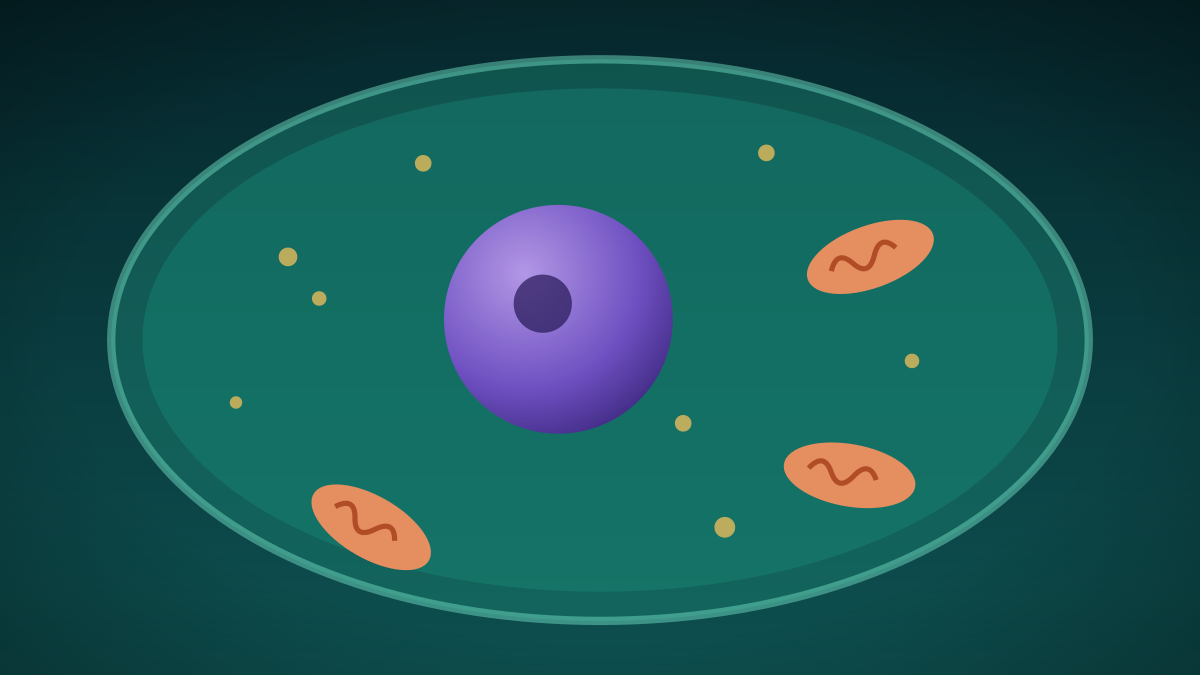
Trillions Strong: Inside the Cell, the Smallest Unit of Life
Every living thing is made of cells, from lone bacteria to the trillions in a human body. A look at the two main cell types and the tiny structures inside them.
What Is an Ecosystem? Living Things, Nonliving Things and the Links Between Them
An ecosystem is a community of organisms together with the air, water and soil they interact with. Agencies and educators explain how energy and materials move through them.
References
- BC Ministry of Education. Life Sciences 11 (BC curriculum). Accessed October 7, 2026.
- BC Ministry of Education. Life Sciences 11 content with elaborations (PDF). Accessed October 7, 2026.
- OpenStax. Biology 2e: Themes and Concepts of Biology. Accessed October 7, 2026.
- The Narwhal. Salmonberry and Heiltsuk knowledge (opinion). Accessed October 7, 2026.
- UBC ETEC 521. Indigenous knowledge blog on plants as timing indicators. Accessed October 7, 2026.
- Simon Fraser University. Researchers continue to unlock mysteries of ancient clam gardens. Accessed October 7, 2026.
These lessons follow the content areas listed in the British Columbia curriculum. They are study material written for this site and are not an official document. The official curriculum is the authority on what each course requires. Lessons are general education, not medical advice.