
Solar Radiation: The Energy Behind Life, Weather and Water
How sunlight powers photosynthesis and food chains, drives wind and ocean currents, distributes energy and nutrients, and powers the water cycle.
🎯 By the end of this lesson
- Students should be able to explain why the equator receives more solar energy per unit area than the poles.
- Students should be able to describe photosynthesis in words and identify its inputs and outputs.
- Students should be able to trace energy through a food chain and explain why energy is lost as heat.
- Students should be able to calculate energy remaining at each trophic level for a given transfer efficiency.
- Students should be able to explain why food chains are short.
- Students should be able to describe how uneven heating drives wind and ocean currents.
- Students should be able to describe the stages of the water cycle and the role of solar energy.
- Students should be able to explain how a biome depends on sunlight, temperature and precipitation.
1The Sun: the engine behind almost everything
Every morning, an enormous amount of energy arrives at Earth from the Sun. That energy lights the planet, warms it, grows its plants, stirs its winds, moves its oceans and lifts water into the sky. Remove it, and nearly all of this would stop.
The BC curriculum expresses this in a single content item: solar radiation provides the energy required for most life on Earth, drives wind and ocean currents, distributes energy and nutrients, and powers the water cycle. This lesson takes each part of that statement in turn.
Solar radiation is energy that reaches Earth from the Sun. It is captured by living things (photosynthesis), it heats the planet unevenly (which drives wind and ocean currents) and it lifts water into the atmosphere (the water cycle). Energy flows through Earth's systems and eventually leaves as heat, while matter cycles and is reused.
The Big Idea behind this lesson and the next ones is that the biosphere (living things), geosphere (rock and soil), hydrosphere (water) and atmosphere (air) are interconnected, as matter cycles and energy flows through them.
2Uneven heating: why latitude matters
The Sun does not warm the whole planet equally. Near the equator, sunlight strikes the surface nearly head-on. At high latitudes (near the poles), the same sunlight strikes at a slant and is spread over a larger area. Averaged over time, the tropics gain more energy than they lose to space, and the poles lose more than they gain.
Latitude also affects how much the amount of sunlight changes through the year. Equatorial regions get steady, direct sunlight, while higher latitudes have strong seasonal swings in daylight and warmth. These differences, together with rainfall, help to decide what kind of ecosystem (biome) can exist in each region.
| Biome | Where and what sunlight and climate are like | Life |
|---|---|---|
| Tropical rainforest | Near the equator; stable temperatures and sunlight year-round; heavy rainfall | Evergreen broadleaf plants grow continuously; very high biomass and many tree species |
| Desert | Around 15 to 30 degrees latitude; evaporation can exceed rainfall | Sparse plants that conserve water; many nocturnal animals |
| Temperate forest | Mid-latitudes; cold winters, warm summers | Deciduous trees lose leaves in winter |
| Boreal forest (taiga) | Just south of the Arctic Circle; long cold winters, short cool summers | Conifers dominate; slow decomposition |
| Tundra | North of the boreal forest; very cold winters; growing season of only 10 to 12 weeks | Low vegetation; permafrost limits roots |
“Summer is warm because Earth is closer to the Sun.” The key factor in climate is the angle at which sunlight strikes the surface and how long the days are, not a large change in distance. Slanted light spreads over more area, which is the idea in the diagram above.
3Capturing sunlight: photosynthesis
Only a few kinds of organisms can capture the energy of sunlight directly. Plants, algae and cyanobacteria are photoautotrophs (“self-feeders using light”). They carry out photosynthesis, which is the only biological process that captures sunlight and stores its energy in the chemical bonds of sugars. Animals, fungi and most bacteria are heterotrophs: they get energy by eating other organisms or their remains.
In words, the process is:
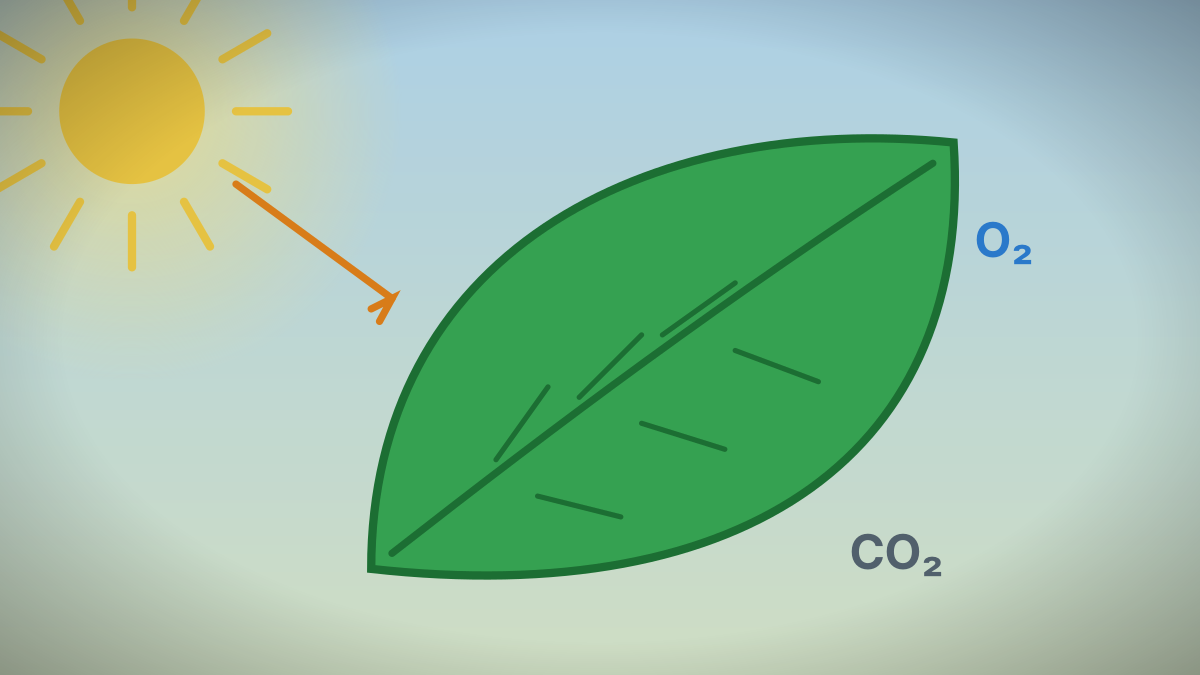
carbon dioxide + water + light energy → sugar + oxygen
In chemical shorthand, six molecules of carbon dioxide and six of water yield one sugar molecule and six oxygen molecules: 6CO2 + 6H2O → C6H12O6 + 6O2.
- Where. In plants, it takes place mostly in the leaf. Gases enter and leave through tiny pores called stomata. Within the cells, photosynthesis happens in chloroplasts, which hold the green pigment chlorophyll.
- Two stages. The light-dependent reactions capture light energy and store it in energy-carrying molecules. The light-independent reactions (the Calvin cycle) use those molecules to build sugars from carbon dioxide.
- Why it matters. Photosynthesis supplies the food energy that moves through food chains, and it releases oxygen that many organisms need. For a longer explanation, see How photosynthesis works.
Life without sunlight
The statement says solar radiation provides energy for most life, not all. Where sunlight does not reach, such as around deep-sea hydrothermal vents, chemoautotrophic bacteria use chemical energy from substances such as hydrogen sulfide released by the vents. They make organic molecules that support a local community of animals such as shrimp, crabs and mussels. These exceptions show that the definition of “energy source” depends on the ecosystem, but for the great majority of ecosystems it is the Sun.
4Energy flows through food chains
Energy enters most ecosystems through producers (autotrophs). From there, it moves along a food chain: producers are eaten by primary consumers (herbivores), which are eaten by secondary consumers, and so on up to apex consumers. Each feeding step is a trophic level. Decomposers break down dead material and recycle nutrients. Many connected food chains form a food web (see What is an ecosystem?).
Energy is lost at each step
At every transfer, a large share of energy is lost, mainly as heat released by the organisms' life processes (consistent with the idea that energy cannot be recycled). Only what remains in the body of the organism is available to the next level.
OpenStax describes a study of an ecosystem in Silver Springs, Florida. Producers captured 20 810 kcal per square metre per year. Respiration and heat used 13 187 of this, leaving 7 633 kcal/m2/yr available to primary consumers.
Share lost: 13 187 ÷ 20 810 × 100 is about 63%. Share left: 7 633 ÷ 20 810 × 100 is about 37%.
The measured efficiency of transfer between the first two trophic levels was about 14.5%. This means that, from that step alone, most of the energy is not passed on, so each higher level has much less to work with.
Because so much energy is lost at each step, only about four to six transfers can occur before too little energy remains to support another level. This is why food chains are short, and why there are fewer top predators than herbivores in most ecosystems. An energy pyramid, with a wide base for producers and narrower layers above, is always upright.
Net production efficiency, the share of assimilated energy that becomes new body mass, differs between animals. A caterpillar (a cold-blooded animal) turns about 18 percent into biomass, while a squirrel (a warm-blooded animal that spends energy on keeping its body warm) may convert as little as 1.6 percent. Warm-blooded animals need more food for the same growth.
5Wind and ocean currents: moving energy around
Because the tropics gain more energy than the poles, the atmosphere and oceans move heat toward higher latitudes. The result is the pattern of global winds and currents.
Wind
Warm air near the equator rises, flows toward the pole high in the atmosphere, and sinks again at around 30 degrees latitude. Some of the sinking air returns toward the equator along the surface; these are the trade winds. The rotation of Earth deflects moving air (the Coriolis effect), so surface winds blow at an angle and form the pattern of trade winds and westerlies, rather than moving in a straight line.
Ocean currents
Ocean currents are movements of water from one place to another. Three forces drive them: tides (strongest near shore), wind (which pushes water at or near the surface and drives currents across whole ocean basins) and differences in water density (caused by temperature and salinity) that set up a slow circulation. Currents carry warm water from the equator toward higher latitudes and cold water from polar regions toward the equator.
The Gulf Stream is a warm ocean current in the North Atlantic. According to NOAA, it keeps winters in Bergen, Norway, milder than those in New York, even though Bergen is much farther north.
Without the current, a city's winter temperature could be predicted from its latitude alone: farther from the equator would be colder. The data for Bergen and New York show that latitude is not the only factor. The current delivers heat, which shows how moving water distributes the Sun's energy.
Distributing nutrients
Currents and winds also move nutrients. Wind near coasts can produce upwelling, which is local rising of water. Rain and runoff carry carbon, nitrogen, phosphorus and sulfur from land into water. In this way, solar-driven movements of air and water spread energy and materials around the biosphere.
6The water cycle: powered by the Sun
Energy from the Sun drives the water cycle by turning liquid water into vapour. Solar energy warms the oceans and other surface waters, which makes water evaporate (and ice sublimate, turning directly into vapour). Plants also return water to the air through their leaves. Together, evaporation and the water released by plants are called evapotranspiration, the main way water enters the air.
- Evaporation and transpiration. Solar energy turns liquid water into vapour.
- Condensation. Rising vapour cools and condenses into clouds.
- Precipitation. Gravity pulls water back to Earth as rain, snow or hail.
- Runoff and infiltration. On land, water flows across the surface as runoff and streamflow, or soaks into the ground and recharges groundwater, which can later reappear in springs and rivers or reach the ocean.
| Water fact (OpenStax) | Value |
|---|---|
| Share of Earth's water that is salt water | About 97.5% |
| Of the 2.5% that is fresh water, share frozen in glaciers or permanent snow | About 68.9% |
| Of fresh water, share that is groundwater (including soil moisture and permafrost) | About 30.8% |
| Of fresh water, share in lakes and rivers | About 0.3% |
| Typical time a water molecule stays in the atmosphere | About 1.5 weeks |
| Typical time in the oceans | About 4,000 years |
“Water is used up when it is drunk or when it rains.” Water is not destroyed. It moves among the atmosphere, oceans, land and underground, and living things. The same water has been cycling for a very long time, and the Sun keeps the cycle moving.
Practice: following energy up a chain
Energy calculations are a good way to test understanding of why chains are short. The example uses the measured transfer efficiency of about 14.5% between the first two levels as an illustration. Real efficiencies vary from one ecosystem and one step to another, so the numbers here are for practice only.
Suppose producers in a meadow make 10 000 units of usable energy. At each step, assume 15% is passed on to the next trophic level.
- Primary consumers (for example, grasshoppers): 15% of 10 000 = 1 500 units.
- Secondary consumers (for example, frogs): 15% of 1 500 = 225 units.
- Tertiary consumers (for example, snakes): 15% of 225 = about 34 units.
- Fourth-level consumers (for example, hawks): 15% of 34 = about 5 units.
By the fourth consumer level, only about 0.05% of the original energy remains. A fifth level would have less than 1 unit, too little to support a population. The calculation gives a reason for the observation that real food chains rarely have more than four to six transfers.
The same logic also explains a practical fact. An ecosystem can support many more individual herbivores than carnivores, because the carnivores depend on the small share of energy that passes up from the herbivores. Pyramids of numbers and biomass can sometimes appear inverted (a few large trees supporting many insects, or tiny fast-growing plankton outweighed by the animals eating them), but a pyramid of energy is always upright.
Reading a climate pattern
A second skill is to connect a biome to its energy input. A reasoning pattern is useful: describe the sunlight, link it to the climate, and then to the organisms.
Question. Why does the tundra have low plant biomass even though the days are nearly continuous sunlight in summer?
Reasoning. The growing season is only 10 to 12 weeks. Winters are very cold and sunlight reaches the surface at a slant, so little energy arrives for most of the year. Permafrost restricts root growth and slows the release of nutrients. Plants are limited by the short season, the cold and the poor supply of nutrients rather than by daylight alone. The result is low vegetation with low diversity and biomass.
The answer ties solar energy to temperature, to the length of the growing season and to the living community.
7Putting the Sun's work together
- For life. Photosynthesis captures sunlight and feeds most food chains; energy is lost as heat at each step and must be resupplied by the Sun.
- For climate. Uneven heating sets up winds and ocean currents that move heat from the tropics toward the poles.
- For matter. The Sun powers the water cycle, which carries materials from land to sea and supports the cycles of other substances covered in the next lesson.
Energy flows in one direction and leaves as heat. Matter cycles. How atoms of carbon, nitrogen and phosphorus move through living and non-living parts of Earth is the topic of the next lesson.
🔑Key terms
?Quick check
Try each question first, then reveal the answer.
1. Why does the equator receive more energy per unit area than high latitudes?
Sunlight strikes the equator nearly head-on, so energy is concentrated on a small area. At high latitudes it strikes at a slant and is spread over a larger area.
2. Write the inputs and outputs of photosynthesis.
Inputs are carbon dioxide, water and light energy. Outputs are sugar and oxygen.
3. Explain why energy flows through an ecosystem but matter cycles.
Energy is lost as heat at each step and cannot be reused, so it must be resupplied by the Sun. Matter is not lost and is recycled by decomposers and other processes.
4. Producers in a lake capture 8000 energy units. If 15% passes to each next level, how much reaches the secondary consumers?
Primary consumers get 15% of 8000, which is 1200. Secondary consumers get 15% of 1200, which is 180 units.
5. Why are there usually fewer top predators than herbivores?
A large share of energy is lost at each transfer, so little energy is left to support the top level.
6. How does uneven heating by the Sun cause wind?
Warm air rises near the equator and cooler air elsewhere moves in, forming circulation patterns. Earth's rotation deflects the moving air into trade winds and westerlies.
7. Describe the water cycle and state which part of it is directly powered by the Sun.
Water evaporates, condenses into clouds, falls as precipitation and returns by runoff and groundwater. Evaporation (and transpiration) is directly powered by solar energy.
8. Explain why a hydrothermal vent community is an exception to the statement that the Sun supports most life.
Chemoautotrophic bacteria at the vents make food using chemical energy from hydrogen sulfide, not sunlight, and they support the other organisms there.
BC curriculum content covered in this lesson
- Effects of solar radiation: solar radiation provides the energy required for most life on Earth, drives wind and ocean currents, distributes energy and nutrients, and powers the water cycle
- Big Idea: The biosphere, geosphere, hydrosphere, and atmosphere are interconnected, as matter cycles and energy flows through them
Related articles
How Photosynthesis Turns Sunlight Into Sugar, Step by Step
Photosynthesis is a two-stage chemical process in chloroplasts that converts light, water and carbon dioxide into sugar and oxygen. Textbooks and ocean scientists explain how it feeds nearly all life.
What Is an Ecosystem? Living Things, Nonliving Things and the Links Between Them
An ecosystem is a community of organisms together with the air, water and soil they interact with. Agencies and educators explain how energy and materials move through them.
References
- BC Ministry of Education and Child Care. Science 9 curriculum (Big Ideas, Content, Curricular Competencies). Accessed October 7, 2026.
- OpenStax. Biology 2e, 8.1 Overview of Photosynthesis. Accessed October 7, 2026.
- OpenStax. Biology 2e, 46.2 Energy Flow through Ecosystems. Accessed October 7, 2026.
- OpenStax. Biology 2e, 46.3 Biogeochemical Cycles. Accessed October 7, 2026.
- OpenStax. Biology 2e, 44.3 Terrestrial Biomes. Accessed October 7, 2026.
- OpenStax. Biology 2e, 44.5 Climate and the Effects of Global Climate Change. Accessed October 7, 2026.
- NOAA National Ocean Service. What is a current?. Accessed October 7, 2026.
- University of Hawaii (open textbook). Chapter 11: General Circulation. Accessed October 7, 2026.
- US Geological Survey. The water cycle (Water Science School). Accessed October 7, 2026.
These lessons follow the content areas listed in the British Columbia curriculum. They are study material written for this site and are not an official document. The official curriculum is the authority on what each course requires. Lessons are general education, not medical advice.