Mitochondria Reported to Shed Membrane to Form New Compartments During Parasite Infection
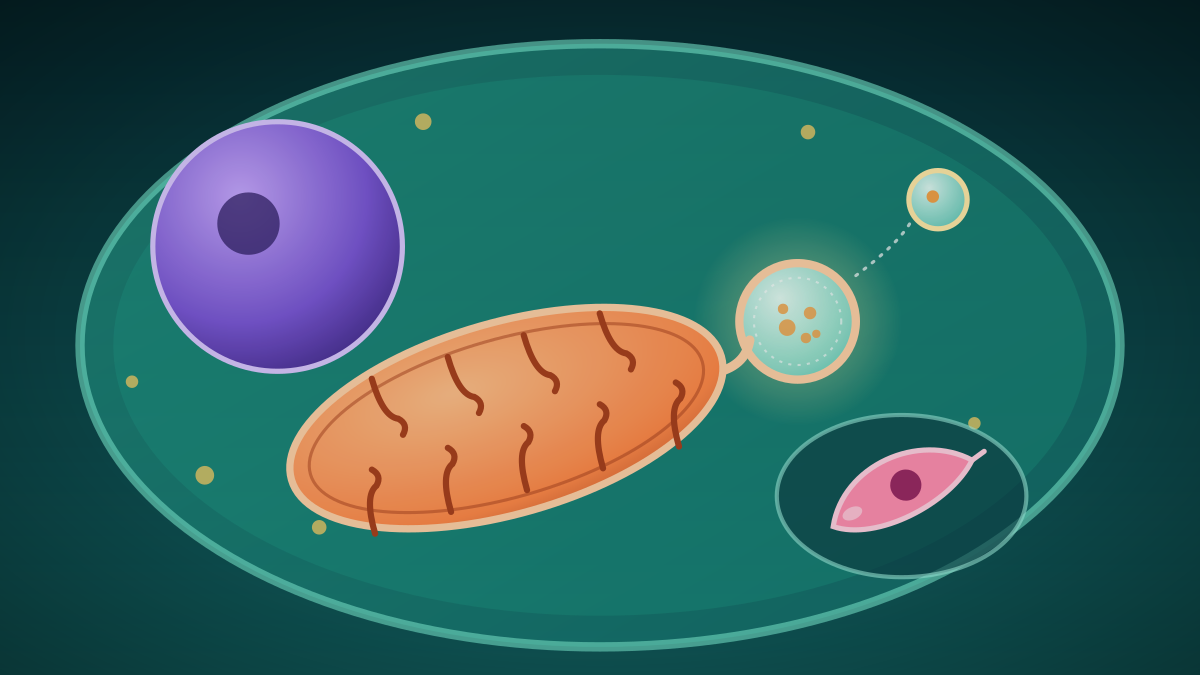
- Mitochondria in cells infected with Toxoplasma gondii were reported to shed outer membrane that forms new compartments.
- The compartments, called SPOTs, may digest cellular waste and are linked to parasite growth.
- The primary report is a preprint, so the findings await peer review and independent confirmation.
An unexpected source of new compartments
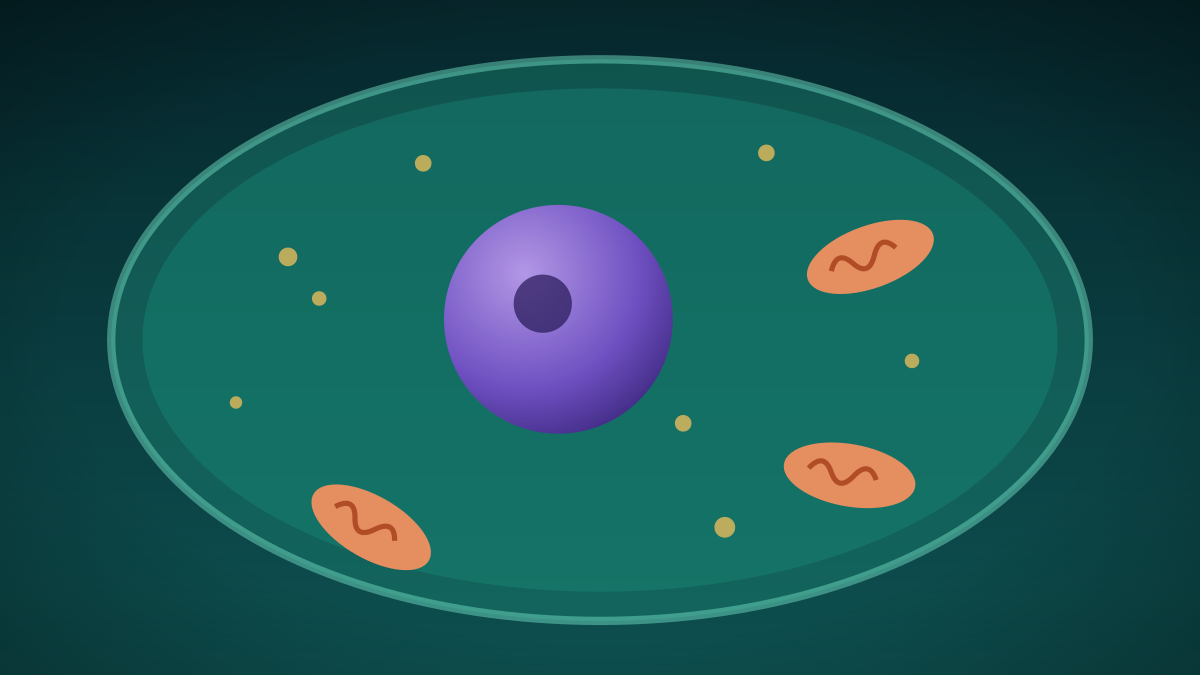
Cells contain organelles, small membrane-bound structures that each carry out a specific job. Mitochondria, the organelles best known for producing energy, are thought to descend from bacteria that were engulfed by an ancestral cell more than a billion years ago. A 2026 report from the laboratory of Lena Pernas at UCLA suggests that mitochondria can also give rise to a different organelle altogether.[1][4]
According to Nature's news coverage, published in April 2026, parasite invasion causes mitochondria to shed their outer layers and form brand-new compartments that digest molecular trash.[1] The finding was framed as supporting a long-standing idea that ancient mitochondria helped create specialised structures inside early complex cells by shedding membrane.[1]
What was observed
The work concerns Toxoplasma gondii, a single-celled parasite that infects human cells.[3] The lab's preprint is titled "Pathogen-induced formation of a nascent organelle derived from mitochondria" and lists Li, Delgado, Sun and Pernas as authors.[4] Summaries of the work state that when the parasite infects human cells, host mitochondria shed their outer layers to generate new compartments called SPOTs, short for structures positive for outer mitochondrial membrane.[3] These compartments are reported to facilitate parasite growth.[3]
The result adds to earlier observations that mitochondria respond to infection and stress. The coverage describes mitochondria as active participants in immune defence rather than passive casualties, able to sense danger and reorganise their membranes.[2]
Why the finding attracted attention
Cell biologist Shaeri Mukherjee of the University of California, San Francisco, who was not part of the work, was quoted as calling it surprising that a pathogen could "not only manipulate the mitochondria, but use the mitochondria to generate an entire new organelle in the cell."[3]
Commentary linked to the discovery suggests it bears on the evolution of cellular complexity, proposing that ancient mitochondria may have helped shape the internal compartments of modern cells.[2] This is an interpretation of how the observation might relate to deep evolutionary history, not something the experiments themselves can demonstrate.[2] Nature's weekly podcast also featured the story under the heading "Stressed mitochondria spawn new 'organelles' in cells."[5]
Caveats and open questions
The principal report listed by the research group is a preprint, a manuscript posted publicly before it has been formally peer reviewed by independent experts.[4] Peer review often leads to changes in methods, analysis and conclusions, so the details reported here could shift.[4]
The studies described involve cultured cells infected in the laboratory, not infections in people or animals.[3] The precise way the parasite uses waste material from the new compartments is described as incompletely understood.[3] Whether similar structures form in other infections or in healthy cells under stress has not been established by the sources reviewed.[2]
The Nature article itself is available only in part without a subscription, so this summary relies on its freely visible text and on secondary descriptions of the preprint.[1] One summary attributes the underlying study to a journal while a Nature news piece references a bioRxiv preprint, a discrepancy that readers should resolve by consulting the original paper when it is available.[1][2]
What to watch for
- Peer-reviewed publication of the SPOTs findings and any revisions made during review.[4]
- Independent laboratories testing whether other pathogens trigger similar mitochondrial membrane shedding.[2]
- Work clarifying how the new compartments contribute to defence or to parasite growth.[3]
Until such results appear, the finding is best regarded as an intriguing early observation about how flexible mitochondria may be, rather than a settled change to textbook cell biology.[1]
References
- Nature. Mitochondria can spawn new 'organelles' — hinting at how modern cells evolved. 2026-04-27. Accessed October 5, 2026.
- World Mitochondria Society. Can Mitochondria Create New Organelles? A Discovery Reopens a Major Question in Cell Biology. 2026-04-28. Accessed October 5, 2026.
- IASVN. Study Shows Mitochondria Can Make New Organelles. 2026-05-08. Accessed October 5, 2026.
- Pernas Lab. Publications — Pernas Lab. Accessed October 5, 2026.
- Nature. Briefing Chat: Stressed mitochondria spawn new 'organelles' in cells. 2026-05-01. Accessed October 5, 2026.
The primary study is a bioRxiv preprint that could not be opened directly (access blocked), so details come from Nature's partly paywalled news piece and secondary summaries, which differ in places. Findings are from infected cultured cells and are not yet peer reviewed.