
Photosynthesis
How chloroplasts transform light energy into the chemical energy of sugars, consuming carbon dioxide and water and releasing oxygen.
🎯 By the end of this lesson
- Write the summary equation for photosynthesis and identify the energy transformation.
- Label the parts of a chloroplast and state what occurs in the thylakoids and the stroma.
- Describe the events of the light-dependent reactions and name their products.
- Explain the source of the oxygen released by photosynthesis.
- Describe the three stages of the Calvin cycle and its inputs and outputs.
- Compare photosynthesis and cellular respiration and chloroplasts and mitochondria.
- Predict how light intensity, carbon dioxide and temperature limit the rate of photosynthesis.
- Design a fair test of the rate of photosynthesis.
1Overview
A tree in a forest gains hundreds of kilograms of wood over its life. Where does that material come from? Soil seems the obvious answer, yet most of a tree's mass is built from carbon dioxide, a gas that makes up a tiny fraction of the air, together with water. The sun supplies the energy for the assembly. Photosynthesis is the process by which light energy is transformed into the chemical energy of sugars, and it also releases the oxygen that most organisms use for cellular respiration.
2Why photosynthesis matters
Organisms are classified by how they obtain energy and carbon. Photoautotrophs (plants, algae and cyanobacteria) make their own food using light. Chemoautotrophs (some bacteria) make sugars from inorganic chemicals instead of light. Heterotrophs (animals, fungi and most bacteria) depend on sugars made by other organisms.
Photosynthesis therefore underlies nearly every food chain. It captures solar energy in the chemical bonds of carbohydrates, and that energy passes along food chains to heterotrophs. It powers most of Earth's ecosystems, supplies the oxygen that many organisms need, and even the fossil fuels in the ground store sunlight energy captured by ancient photosynthesis. See also the article on how photosynthesis works.
3The equation and the energy transformation
The curriculum summarizes photosynthesis as a process that consumes carbon dioxide and water and produces oxygen and sugars:
6 CO2 + 6 H2O + light energy → C6H12O6 + 6 O2
This is the reverse of the cellular respiration equation, but the two processes are not the same pathway run backwards. They occur in different organelles using different enzymes and carriers. In terms of energy, light energy becomes chemical energy stored in sugar, and respiration later converts that chemical energy into ATP.
| Feature | Photosynthesis | Cellular respiration |
|---|---|---|
| Energy change | Light energy to chemical energy in sugar | Chemical energy in sugar to chemical energy in ATP (and heat) |
| Reactants | CO2, H2O | Glucose, O2 |
| Products | Sugar, O2 | CO2, H2O, ATP |
| Where (eukaryotes) | Chloroplasts | Cytoplasm and mitochondria |
| Who does it | Photoautotrophs | Nearly all organisms |
Plants do not photosynthesize instead of respiring. Plant cells have both chloroplasts and mitochondria. Photosynthesis makes sugar; mitochondria then break some of that sugar down to make ATP, and the plant uses it to grow and maintain itself.
The oxygen released does not come from the carbon dioxide. It comes from the splitting of water in the light-dependent reactions.
4Where photosynthesis happens: leaf, cell, chloroplast
In plants, photosynthesis occurs mainly in the mesophyll layer of leaves. Carbon dioxide enters through pores called stomata, diffuses to mesophyll cells and into the chloroplasts. A chloroplast has a double membrane. Inside it are flattened discs called thylakoids, which contain chlorophyll and electron transport proteins and enclose a space called the thylakoid lumen. Stacks of thylakoids are grana. The fluid surrounding the grana is the stroma.
Photosynthesis has two linked stages. The light-dependent reactions convert light energy into the chemical energy of ATP and NADPH and release oxygen. The light-independent reactions (the Calvin cycle) use that ATP and NADPH to build sugar from carbon dioxide. Neither can run without the other.
Stage 1: the light-dependent reactions
Capturing light
The main light-capturing pigments in plant chloroplasts are chlorophyll a and chlorophyll b. They absorb mainly blue and red light and reflect green light, which is why leaves look green. Carotenoids help absorb excess energy and release it safely as heat. Antenna pigments pass captured energy from molecule to molecule until it reaches a reaction center, where light energy excites an electron.
The sequence of events
- Light excites electrons in photosystem II (PSII), a protein complex in the thylakoid membrane.
- PSII replaces its lost electrons by taking them from water. Splitting two water molecules releases one molecule of O2, which is the oxygen given off by plants.
- Excited electrons move along an electron transport chain to photosystem I (PSI). The energy they lose pumps hydrogen ions into the thylakoid lumen, producing a gradient.
- H+ flowing back out through ATP synthase drives the synthesis of ATP. This resembles chemiosmosis in the mitochondrion.
- PSI absorbs another photon to re-energize the electrons, which reduce NADP+ to NADPH.
| Light-dependent reactions | Detail |
|---|---|
| Location | Thylakoid membranes |
| Inputs | Light, water (plus ADP and NADP+) |
| Outputs | ATP, NADPH, O2 |
Stage 2: the Calvin cycle
The Calvin cycle (also called the Calvin-Benson cycle, or light-independent reactions) occurs in the stroma. The old name "dark reaction" is discouraged because the cycle does not need light directly, although it depends on the ATP and NADPH that light reactions supply. It has three stages:
- Fixation. The enzyme RuBisCO attaches CO2 to RuBP, a five-carbon molecule. Each CO2 yields two molecules of 3-PGA. Inorganic carbon is now in an organic molecule.
- Reduction. ATP and NADPH convert 3-PGA into G3P (glyceraldehyde 3-phosphate), a three-carbon sugar.
- Regeneration. Five of every six G3P molecules are used to regenerate RuBP, using more ATP, so the cycle can continue. One G3P leaves the cycle for every three CO2 fixed.
Question: How many CO2 molecules must be fixed to make one six-carbon glucose?
Answer: Glucose has 6 carbons, and each CO2 contributes one carbon, so 6 CO2 must be fixed. Since one G3P (3 carbons) exits per three turns of the cycle, two G3P require six turns, and the two G3P can then be joined to make glucose. This matches the 6 CO2 in the summary equation.
The two stages are connected by the carriers. ATP and NADPH made in the thylakoids are consumed in the stroma. The ADP and NADP+ left over return to the thylakoids to be recharged, in the same way that ADP and NAD+ cycle through cellular respiration.
Energy accounting in the Calvin cycle
Question: How much ATP and NADPH does the Calvin cycle use to make one glucose?
Answer: Fixing three CO2 produces six molecules of 3-PGA. Reducing six 3-PGA to G3P uses 6 ATP and 6 NADPH. Regenerating RuBP uses 3 more ATP. So three CO2 fixed (and one G3P exported) costs 9 ATP and 6 NADPH. Glucose needs two G3P, so six CO2 fixed costs 18 ATP and 12 NADPH. These molecules are supplied by the light-dependent reactions, which is why the two stages must stay in step.
What happens to the sugar?
G3P exported from the cycle is built into glucose and other carbohydrates. These serve as long-term energy storage and as building blocks for other compounds. Plant cells can burn some of the glucose through cellular respiration for ATP, and use the rest to build structures such as cellulose in cell walls. The carbon in wood, leaves and fruit started as atmospheric CO2.
The oxygen released moves into the atmosphere. The early atmosphere was anoxic for roughly two billion years. Photosynthetic prokaryotes later began oxygenating the atmosphere, which made oxygen-using respiration possible, as the previous lesson described.
5Factors that limit the rate of photosynthesis
The rate of photosynthesis depends on the supply of what the process needs. A limiting factor is the one in shortest supply, which sets the rate until it is increased.
- Light intensity. Dim light limits the rate. Brighter light speeds photosynthesis up to a point, then the rate levels off.
- Carbon dioxide concentration. At low levels CO2 limits the rate. Raising it increases the rate until another factor takes over.
- Temperature. Photosynthesis relies on enzymes. Warmer conditions speed them up until an optimum; above that, enzymes are damaged (denatured) and the rate falls.
A common lab method uses cut pondweed in a sodium hydrogen carbonate solution (a CO2 source) with a lamp at measured distances. Counting oxygen bubbles per minute at each distance, and averaging repeats, shows how rate depends on light intensity. Because light intensity falls off with the square of the distance, the relationship is not a straight line. Keeping temperature steady (for example with a water tank between lamp and plant) controls an important variable. Greenhouse growers apply the same ideas by supplying light, carbon dioxide and suitable temperatures.
Chloroplasts and mitochondria compared
The two energy organelles have a striking similarity: each has a double membrane, its own DNA, and an internal membrane system where a proton gradient drives an ATP synthase. This resemblance is part of the evidence for the endosymbiotic theory (see lesson two): chloroplasts descend from cyanobacteria and mitochondria from alpha-proteobacteria.
| Feature | Chloroplast | Mitochondrion |
|---|---|---|
| Found in | Plants and algae | Nearly all eukaryotes |
| Outer boundary | Double membrane | Double membrane |
| Internal membrane | Thylakoids (stacked as grana) | Inner membrane with folds (cristae) |
| Fluid compartment | Stroma (Calvin cycle) | Matrix (citric acid cycle) |
| Energy converted | Light to chemical (sugar) | Chemical (sugar) to chemical (ATP) |
| Proton gradient used for | Making ATP in the light reactions | Making ATP in oxidative phosphorylation |
| Own DNA and ribosomes | Yes | Yes |
6Photosynthesis beyond plants
Plants are not the only photosynthesizers. Algae and cyanobacteria also use light to make sugar, and cyanobacteria are prokaryotes and therefore have no chloroplasts. Fossil evidence of microbial mats about 3.5 billion years old suggests that prokaryotic life was established long before plants. Some other bacteria are chemoautotrophs, which make sugars from inorganic chemicals instead of light, showing that "making one's own food" can be done without the sun.
The ability to photosynthesize arose in prokaryotes and reached eukaryotes when a eukaryote took up a cyanobacterium. Photosynthetic life is therefore not a single lineage but the result of an ancient partnership, a pattern that comes up again in the evolution lessons.
7Photosynthesis in the bigger picture
Photosynthesis and cellular respiration form a cycle of matter and a flow of energy. Carbon atoms move from atmosphere to sugar (photosynthesis) and back to atmosphere (respiration). Energy, in contrast, does not cycle: sunlight enters, passes through food chains, and leaves as heat. Because photosynthesis supports nearly all ecosystems, changes to the number of photosynthetic organisms, whether on land or in the ocean, can affect whole communities. Many organisms in turn depend on these producers: animals eat plants or eat other animals that did.
Thinking in terms of matter and energy gives a useful test question for any ecosystem: where does the energy come from, and where does the carbon end up? For a forest, the energy comes from the sun and is captured by trees; the carbon is stored in wood and leaves, passed to herbivores and decomposers, and returned to the air as carbon dioxide when organisms respire or when dead material is broken down. The ecosystem lesson in the first unit and the energy lessons here describe the same system at different scales.
Fossil fuels such as coal and oil store sunlight energy captured by ancient photosynthesis. Burning them returns that carbon to the atmosphere as CO2, within a short time compared with the many years over which the energy was originally stored.
8Summary
- Photosynthesis consumes CO2 and water and produces oxygen and sugars, transforming light energy into chemical energy.
- It occurs in chloroplasts: light reactions in the thylakoid membranes and the Calvin cycle in the stroma.
- Light reactions make ATP and NADPH and release O2 from the splitting of water.
- The Calvin cycle fixes CO2 using RuBisCO, reduces it to G3P and regenerates RuBP.
- Light intensity, CO2 concentration and temperature can each limit the rate.
- Photosynthesis and respiration complement each other in the flow of energy and cycling of carbon.
🔑Key terms
?Quick check
Try each question first, then reveal the answer.
1. State the summary equation for photosynthesis in words and symbols.
Carbon dioxide and water, using light energy, produce glucose and oxygen: 6 CO2 + 6 H2O + light energy gives C6H12O6 + 6 O2.
2. Where does the oxygen released in photosynthesis come from?
It comes from water, which is split in the light-dependent reactions at photosystem II. It does not come from carbon dioxide.
3. Where in the chloroplast do the light-dependent reactions and the Calvin cycle occur?
The light-dependent reactions occur in the thylakoid membranes and the Calvin cycle occurs in the stroma.
4. Why do leaves appear green?
Chlorophyll absorbs mainly blue and red light and reflects green light, so the reflected green light reaches the eye.
5. What are the products of the light-dependent reactions and how are they used?
The products are ATP, NADPH and oxygen. ATP and NADPH supply energy and electrons to the Calvin cycle, and oxygen is released.
6. Describe the three stages of the Calvin cycle.
In fixation, RuBisCO attaches CO2 to RuBP to form 3-PGA. In reduction, ATP and NADPH convert 3-PGA to G3P. In regeneration, most G3P is used to remake RuBP so the cycle continues, and one G3P leaves for every three CO2 fixed.
7. A plant is in bright light but in air with very little carbon dioxide. Predict what limits the rate of photosynthesis and what would happen if the CO2 were increased.
Carbon dioxide is the limiting factor. Raising it would increase the rate until another factor, such as light or temperature, becomes limiting.
8. Compare chloroplasts and mitochondria in two ways that are similar and two that are different.
Both have double membranes, their own DNA and a proton gradient that drives ATP synthase. Chloroplasts convert light to chemical energy in sugar and are found in plants and algae, whereas mitochondria convert the chemical energy of sugar to ATP and are found in nearly all eukaryotes.
BC curriculum content covered in this lesson
- energy transformations: photosynthesis (consumes carbon dioxide and water, produces oxygen and sugars)
- energy transformations: both processes occur in cells (chloroplast structure)
Related articles
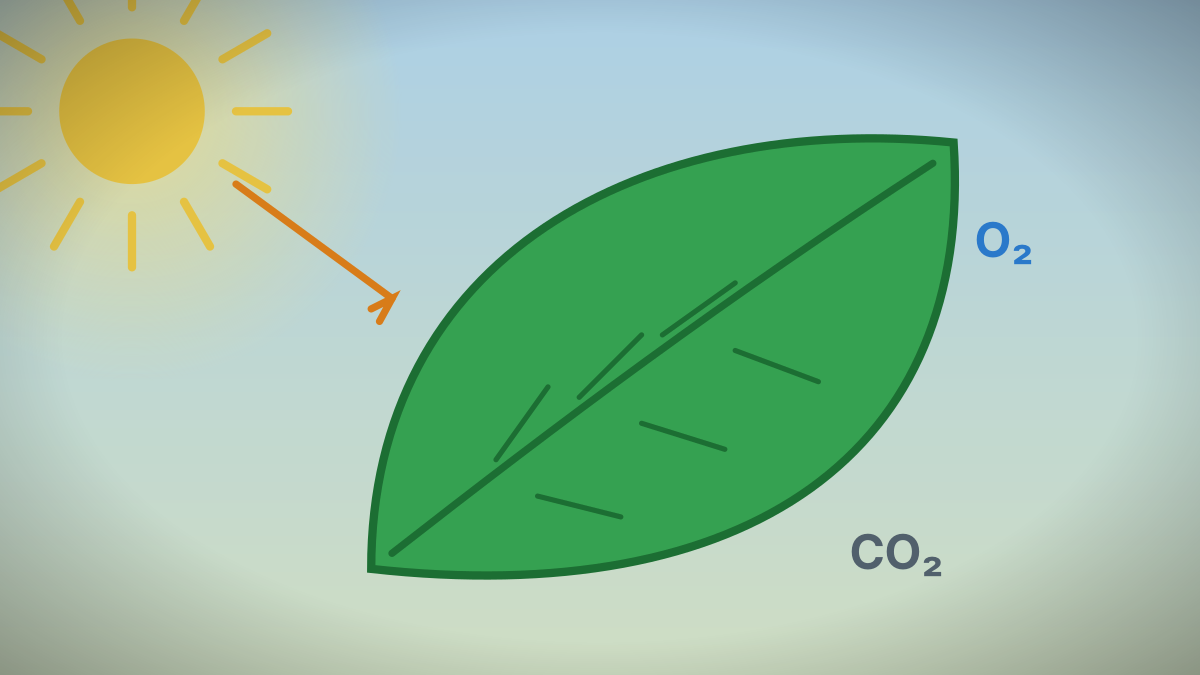
How Photosynthesis Turns Sunlight Into Sugar, Step by Step
Photosynthesis is a two-stage chemical process in chloroplasts that converts light, water and carbon dioxide into sugar and oxygen. Textbooks and ocean scientists explain how it feeds nearly all life.
What Is an Ecosystem? Living Things, Nonliving Things and the Links Between Them
An ecosystem is a community of organisms together with the air, water and soil they interact with. Agencies and educators explain how energy and materials move through them.
References
- BC Ministry of Education. Life Sciences 11 (BC curriculum). Accessed October 7, 2026.
- OpenStax. Biology 2e: Overview of Photosynthesis. Accessed October 7, 2026.
- OpenStax. Biology 2e: The Light-Dependent Reactions of Photosynthesis. Accessed October 7, 2026.
- OpenStax. Biology 2e: Using Light Energy to Make Organic Molecules. Accessed October 7, 2026.
- OpenStax. Biology 2e: Eukaryotic Origins. Accessed October 7, 2026.
- OpenStax. Biology 2e: Prokaryotic Diversity. Accessed October 7, 2026.
- Britannica. Photosynthesis. Accessed October 7, 2026.
- MME Revise. Rate of Photosynthesis. Accessed October 7, 2026.
These lessons follow the content areas listed in the British Columbia curriculum. They are study material written for this site and are not an official document. The official curriculum is the authority on what each course requires. Lessons are general education, not medical advice.